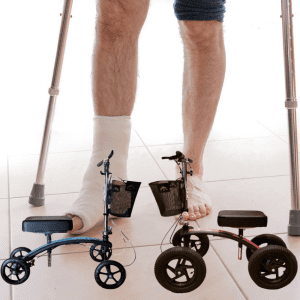
Walk into a medical supply store or open a few online listings, and you’ll notice something almost immediately: most knee scooters look alike. Similar frames. Similar handlebars. Similar claims. The differences usually don’t stand out until you start looking a little closer.
That’s why knowing what to look for in a knee scooter before you choose one can save you from ending up with the wrong fit for your recovery.
Knee Scooter Reality Check: Seven Details Worth Your Attention
Price tags and star ratings won’t tell you if a scooter actually works for your body. Your daily routine, either. Seven specific details decide that. Know them, and comparing any model, or any rental, takes minutes. Not hours.
Get Your Fit Right First: Weight Capacity and Height Range
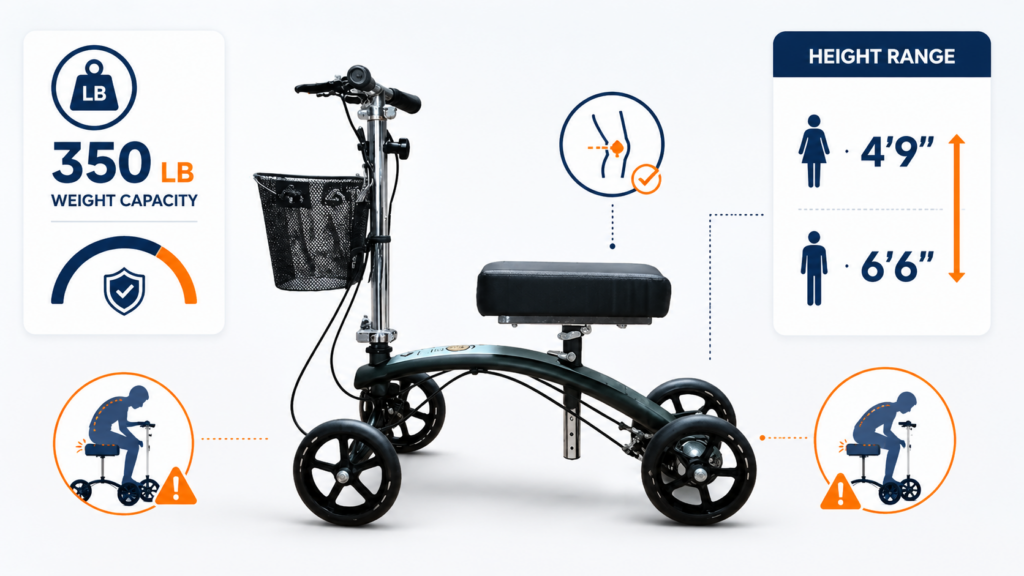
Every model has a hard ceiling on rider weight. A specific height window too. Skip past that spec, and you’re gambling. Most knee scooters top out around 350 pounds, with a standard model fitting riders from about 4’9″ to 6’6″.
All-terrain starts a bit higher, closer to 5’0″. Go outside either range, and you’re not just uncomfortable. You’re asking the frame and the knee pad to do a job they weren’t built for.
- Check the exact weight capacity against your own weight, not a rounded-up estimate
- Confirm your height actually falls inside the model’s stated range, since “one size fits most” is a marketing line, not a spec
- Remember that riding outside the range often shows up as knee pad misalignment or frame strain that builds over weeks, not day one
Quick gut check: If you have to squint at the weight and height range to convince yourself you’re “close enough,” that’s the scooter telling you to look at a different model.
Match the Wheels to Where You’ll Actually Ride
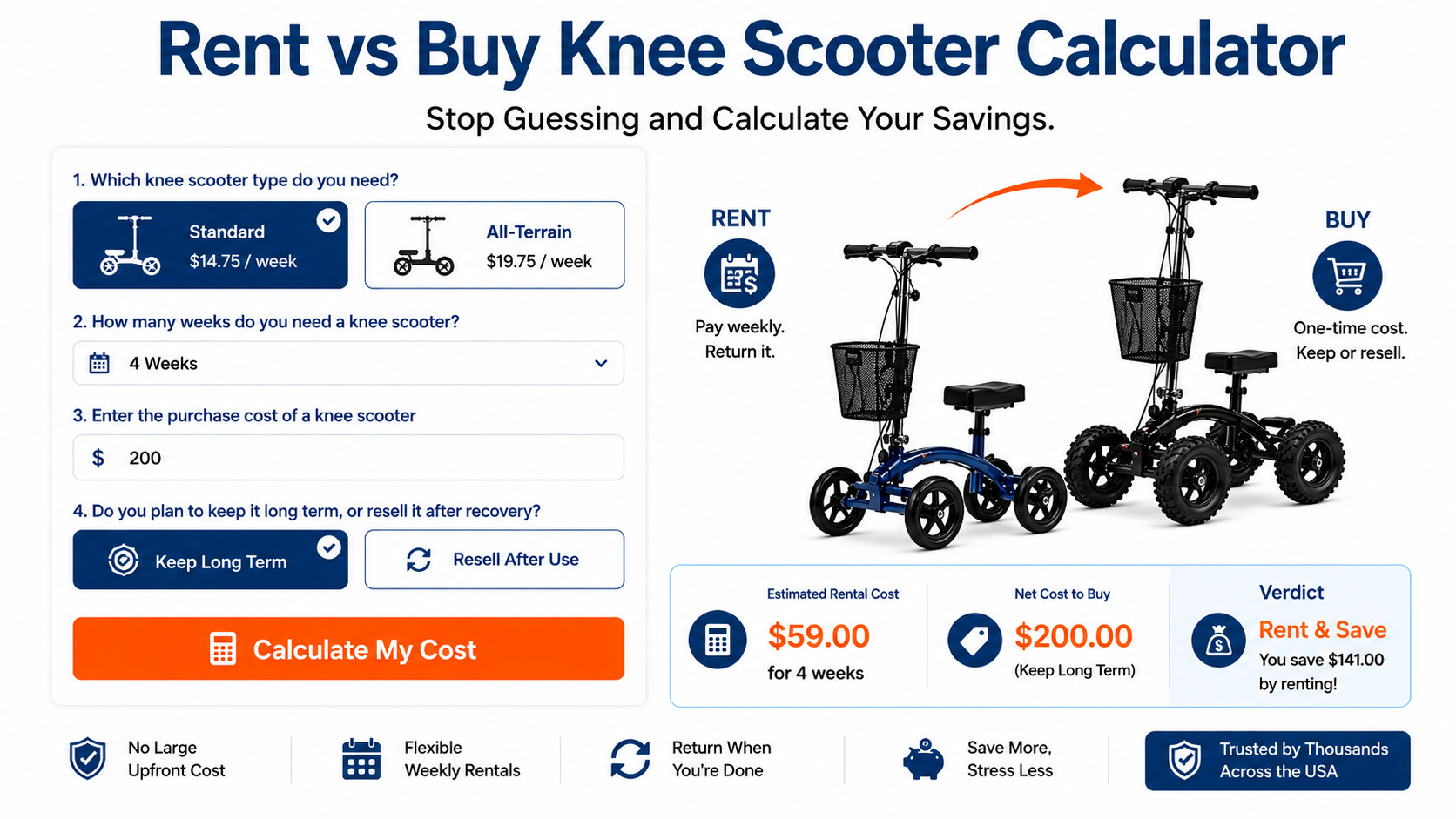
A knee scooter’s wheels aren’t interchangeable in practice. They just look similar in photos. Standard scooters run on 7-inch solid rubber tires built for carpet, tile, hardwood, and smooth sidewalks. All-terrain models swap in 12-inch air-filled tires made for gravel, grass, dirt, and rougher outdoor ground.
- Solid tires on gravel mean every rock and crack transmits straight into the frame, and into your leg
- Air-filled tires indoors are overkill, and they’re clumsy to maneuver in small rooms
- Think through your actual daily route (home, car, yard, sidewalk) instead of the one trip you might take once
Example: Someone commuting from a paved driveway to a smooth office floor rarely needs the tires built for gravel and dirt. Someone with a long unpaved driveway almost always does.
Make Sure the Knee Pad and Handlebars Actually Adjust
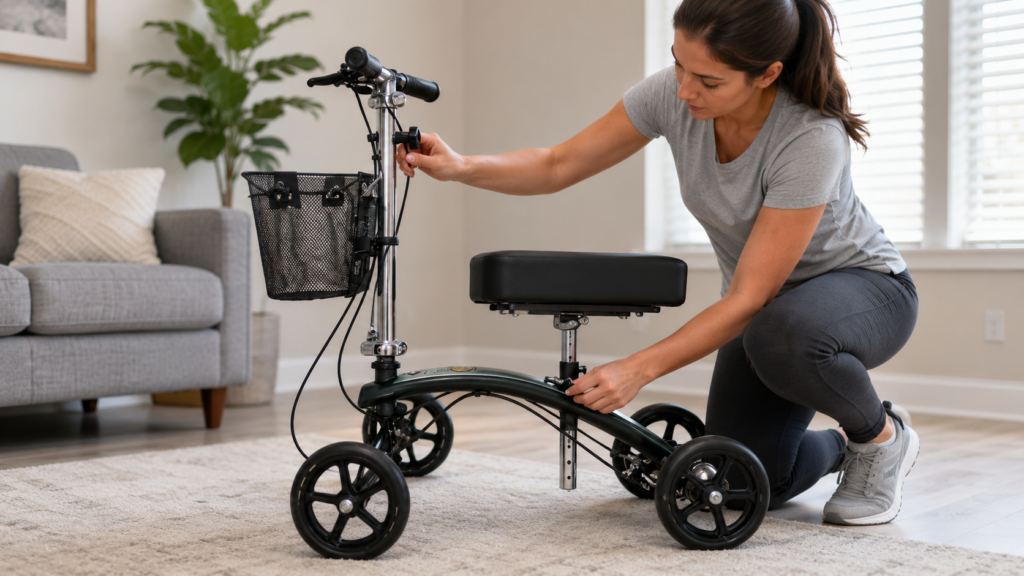
A scooter that can’t be dialed in to your exact height won’t feel right, no matter how nice it looks in the listing. Both the knee pad and the handlebars need independent height adjustment. And the locking mechanism holding those settings in place? Matters just as much as the range itself.
- Knee pad height that’s off by even an inch forces your good leg to compensate, which is usually where shoulder and lower-back strain during recovery starts
- Handlebars should land around waist height once you’re standing in position, not somewhere you have to reach or hunch for
- A pin or clamp that holds firm under weight beats a knob that slowly slips
Pro tip: Always lock the adjustment knob fully after setting it. A pad that shifts mid-ride won’t warn you before it becomes a problem.
Think About Turning Radius Before You Think About Speed
Outdoor performance gets all the attention. But it’s the indoor moments – bathrooms, hallways, tight kitchen corners, where a scooter’s footprint really shows up. A model that cruises fine down a sidewalk can still be a daily headache if it can’t pivot in a small room.
- Picture the tightest doorway or hallway in your home and whether the scooter can turn there without three-point-turning
- Overall length and width matter more indoors than they do outdoors
- A wider turning radius isn’t a dealbreaker outside, but it will wear on you fast inside
Heads up: Even a well-sized scooter has one real limitation indoors. Don’t assume a model that handles the driveway will handle your hallway just as well.
Don’t Skip the Brakes
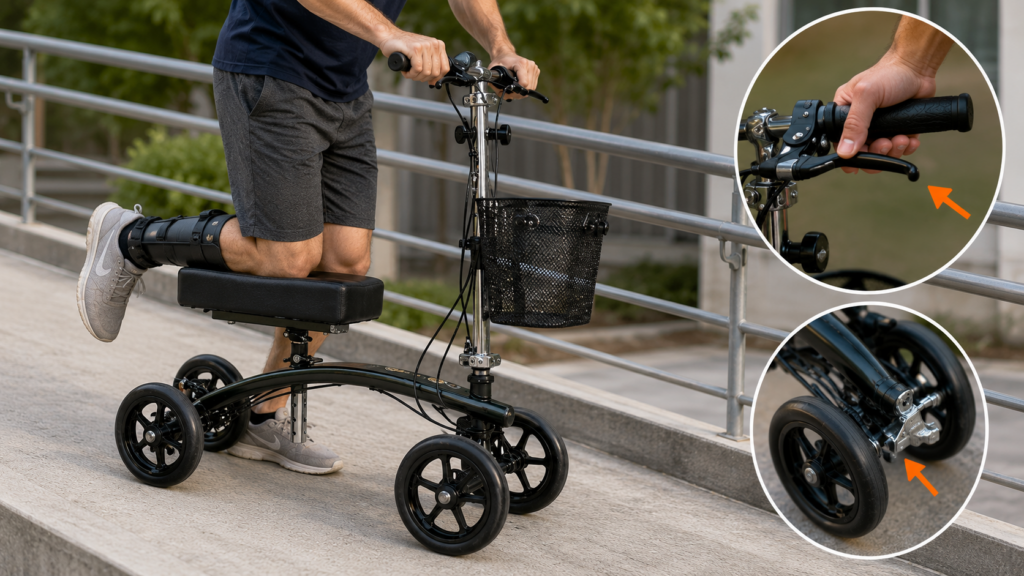
The brake does more work than people expect. It’s not just for emergencies. It’s for every single stop. Look for dual hand-operated brake levers with a parking-brake lock, since that lock is what keeps the scooter still while you’re getting on or off.
- Response matters: a brake that grabs quickly beats one that needs a hard, prolonged squeeze
- The parking-brake lock should hold firm on a slight incline, not just flat ground
- A soft or delayed brake is often the real difference between a controlled stop and a fall
Example: On a ramp or a slight slope, you want the brake to slow you gradually with a light squeeze. Not an all-or-nothing grab.
Check How It Folds and How Much It Weighs
Needs to fit in a car trunk, maybe up a single step, or into a small apartment. Once portability enters the picture, it stops being a nice-to-have. Weight and folding mechanism both factor in here, and they matter most for whoever’s actually lifting it.
- Confirm you (or whoever’s helping) can fold or lift it one-handed, since you’re the one who’s injured
- A foldable frame makes a real difference for car trips and small living spaces
- Lighter isn’t automatically better if it sacrifices stability, so weigh both factors together
Pro tip: most airlines treat folded knee scooters like wheelchairs or walkers at the gate. Portability can matter even outside your own four walls.
Look Past the Marketing Extras
Baskets, cup holders, padded knee rests; none of it makes or breaks your safety. But it adds up over 3 to 4 weeks of daily use. These are the details that separate “it works” from “it’s actually pleasant to use every day.”
- A storage basket means hands-free carrying instead of balancing items on your lap
- A cup holder sounds minor until week two, when it isn’t
- Extra padding on the knee rest reduces pressure points on longer trips out
Example: Two scooters with identical specs can feel completely different once you factor in whether one has a basket built for actual daily errands.
Notice what’s missing from all seven: price tag, brand name, star rating. None of that tells you how a scooter actually feels on day twelve of your recovery.
Fit, terrain, adjustability, turning radius, brakes, portability, comfort; those are the things that hold up under real, daily use. Run any model through them, and you won’t need a spec sheet or a sales pitch to know if it’s the right one.
Beat The Wait: How Fast You Can Actually Get Moving
Fit and features matter. So does the clock. A scooter with a perfect spec sheet still leaves you stuck on one leg if getting your hands on it takes three days and an appointment.
The Old Way: In-Person Visits and Limited Hours
Most local medical supply stores run like a doctor’s office, not a store. You call, you book a slot, you show up during a narrow window; miss it, and tomorrow’s your next shot.
- Many don’t have an online storefront at all, so getting fitted means walking in during whatever hours they happen to keep
- Weekends are usually a dead end, and so is anything after 6 pm on a weekday
- That gap lands at the worst possible moment, since injuries don’t wait for business hours either
Reality check: an ankle fracture that happens on a Saturday night doesn’t care that the nearest store reopens Monday at 9.
The Faster Way: Same-Day, No Appointment Needed
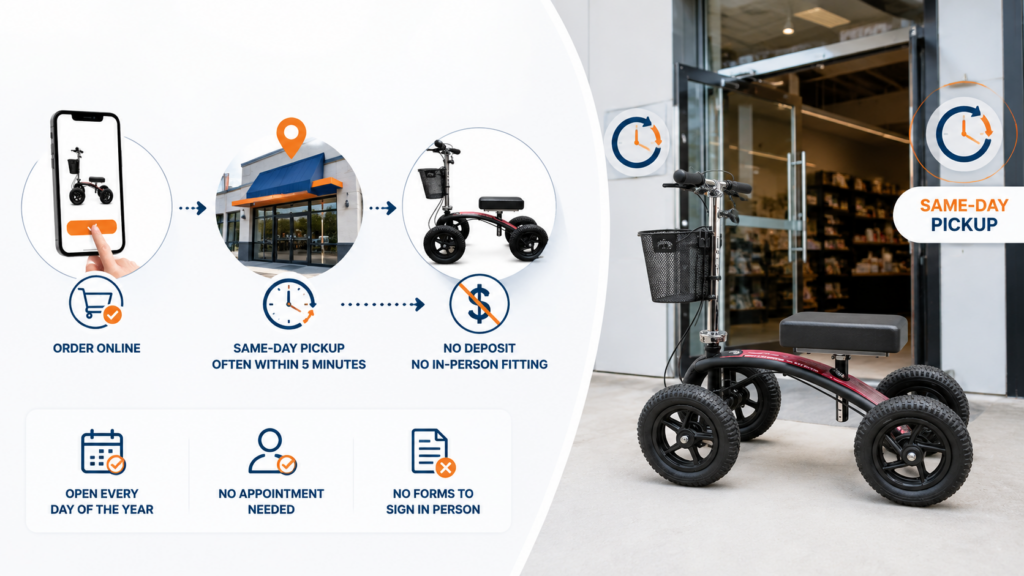
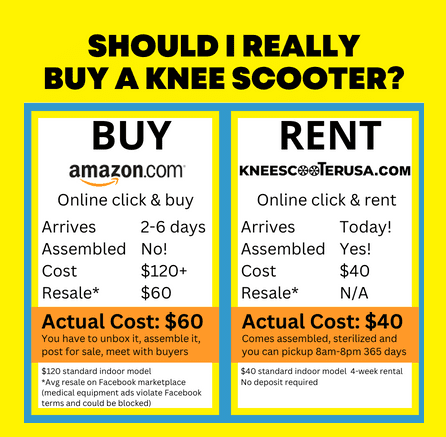
Knee Scooter USA skips the office model entirely and runs closer to a convenience store. Open every single day of the year, no waiting room, no forms to sign in person.
- Book online from your phone, even from the waiting room after your appointment
- Pick up (or send a friend to pick up) the same day, often within 5 minutes of ordering
- No deposit, no in-person fitting required before you can walk out the door
Example: Same-day local pickup means someone who breaks an ankle Saturday night doesn’t wait until Monday. They’re moving that same evening instead.
Speed isn’t a bonus feature buried at the bottom of the list. For anyone dealing with a fresh injury, how fast you can actually get one belongs right up there with fit and weight capacity, maybe even ahead of them.
Your Recovery Deserves More Than A Guess
The best knee scooter isn’t the one with the highest rating or the longest feature list. It’s the one that fits your height, supports your weight, matches where you’ll use it, and feels comfortable every day of recovery. Taking a few extra minutes to compare those details now can save weeks of frustration later.
If you’re ready to put these tips into practice, Knee Scooter USA makes it easy to find the right model with same-day pickup, no deposit, and online ordering.
Browse our locations and get moving without the wait.