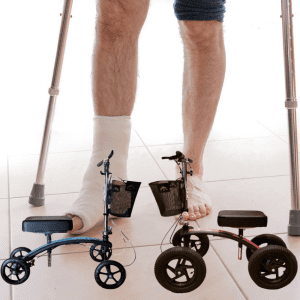
You just left the ER with a boot, a set of crutches, and doctor’s orders to stay “non-weight-bearing” for the next six weeks. Ten minutes in, your armpits already ache and you’ve nearly fallen twice just getting from the couch to the kitchen.
If you were wondering what a knee scooter is, you’ve landed in the right place.
To explain it shortly, a knee scooter is a wheeled mobility device that lets you get around on one leg while your injured foot or ankle stays elevated and out of the way. Instead of balancing your whole body weight on your hands and underarms, you rest your bent knee on a padded platform and steer with handlebars, no armpit bruises required.
How Knee Scooters Work: The Basics

A knee scooter is a four-wheeled mobility aid built for one job: keeping your weight off an injured foot or ankle without forcing you onto crutches or into a wheelchair.
When you rent a knee scooter, instead of balancing on your hands, here’s how it actually works:
- Rest your injured leg on a padded knee platform with your knee bent at roughly 90 degrees
- Push with your good leg to move forward (no hopping required)
- Steer and brake using adjustable handlebars and hand brakes, just like a bike
- Rely on the four-wheel base for stability – you’re not fighting balance the way you would on crutches
What You Get:
- Available in pediatric, adult, and big & tall sizes
- Most models fold down for easy storage and transport
- Lightweight enough to carry through doorways but sturdy enough for outdoor use
What Do People Call a Knee Scooter?
So, what is a knee scooter called, exactly? It depends on who’s asking.
Doctors and physical therapists usually say “knee walker.” Insurance paperwork might list it under a generic “knee scooter” line item. And if you’ve ever wondered what the knee scooter is called on a rental company’s website versus in a hospital supply closet, the honest answer is: it’s inconsistent.
Knee walker, knee caddy, leg scooter, orthopedic scooter: whatever knee scooter name you’ve come across, they’re all describing the same four-wheeled device.
And to directly answer the other common version of this question: what is a knee walker, if not a knee scooter? Nothing; they’re interchangeable terms for the exact same product. If a site or a nurse says “knee walker” and another says “knee scooter,” neither one is wrong.
What Does a Knee Scooter Look Like?
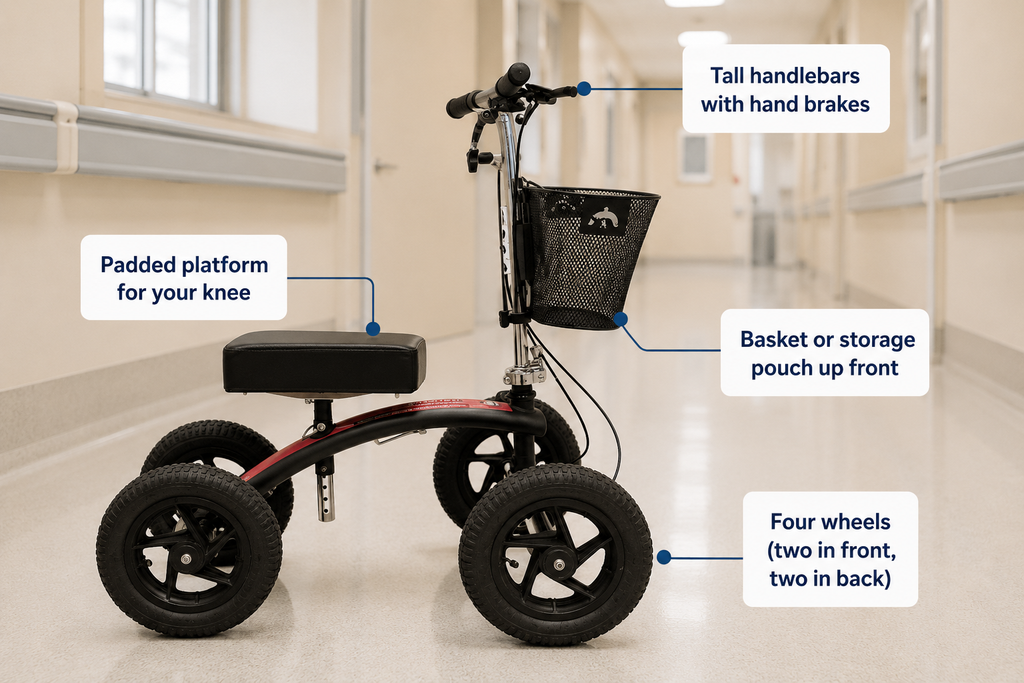
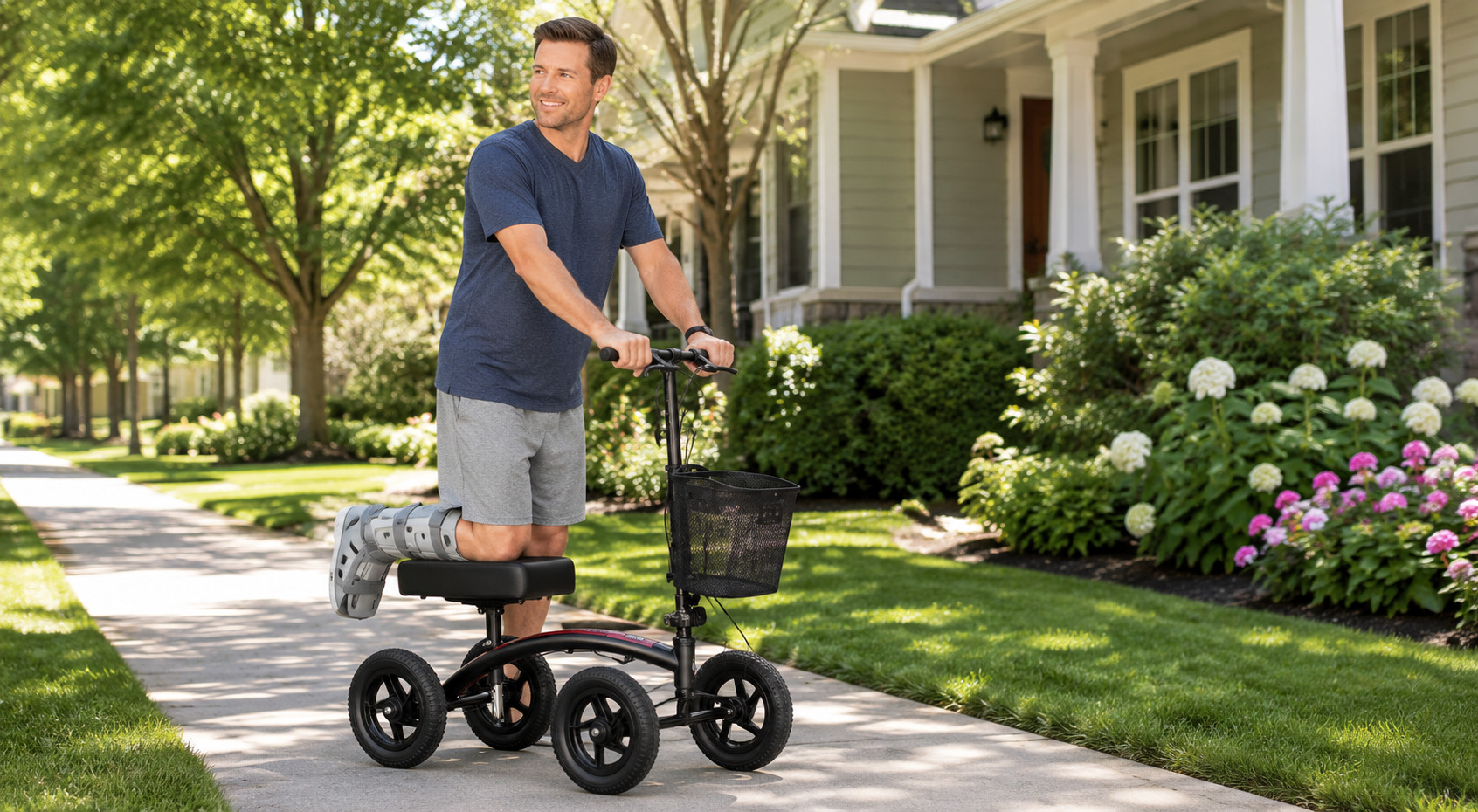
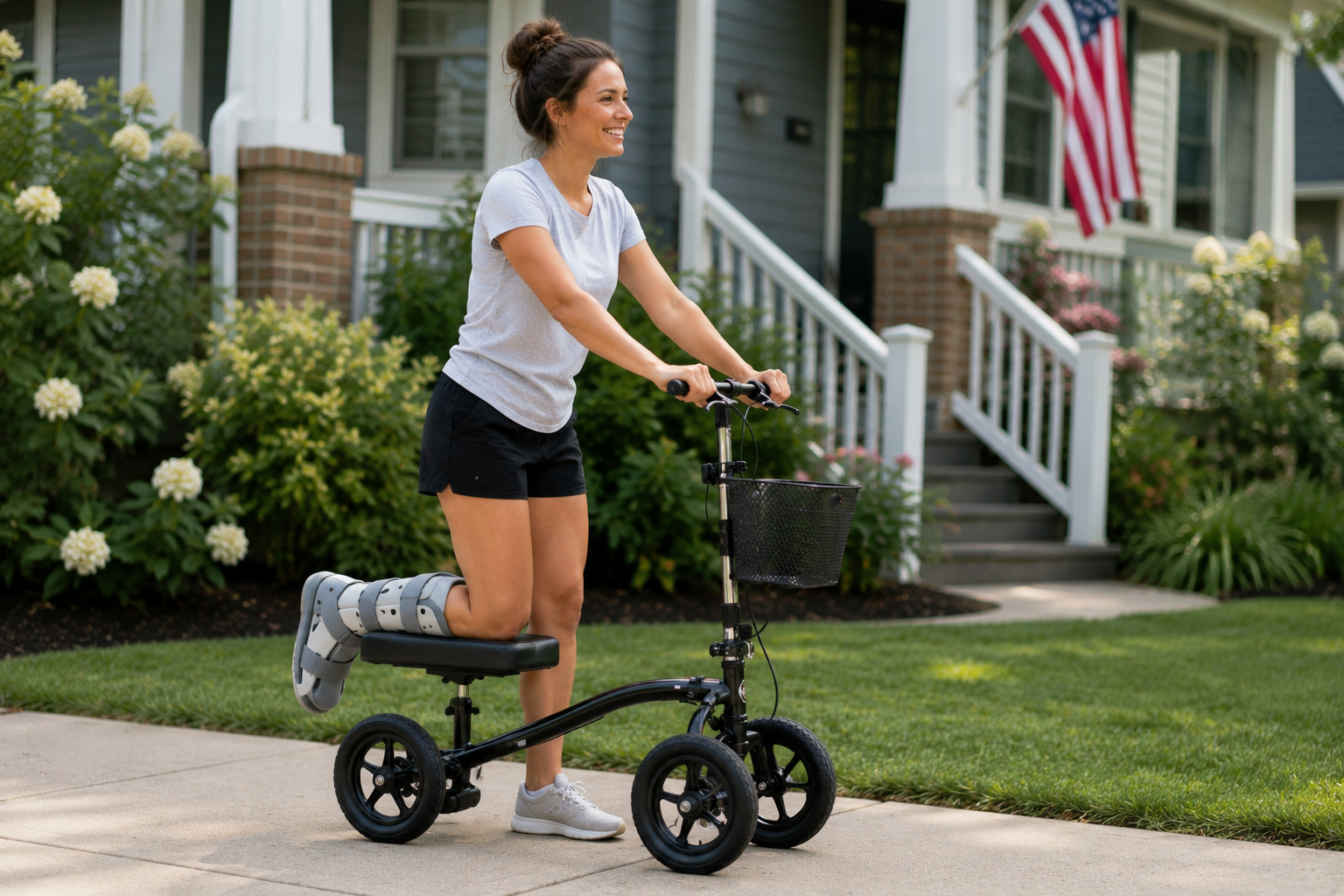
Picture a scooter a kid would ride, but built for a hospital hallway instead of a sidewalk. It has four wheels (two in front, two in back), a padded platform where your knee rests, and tall handlebars with hand brakes, similar to a bicycle’s.
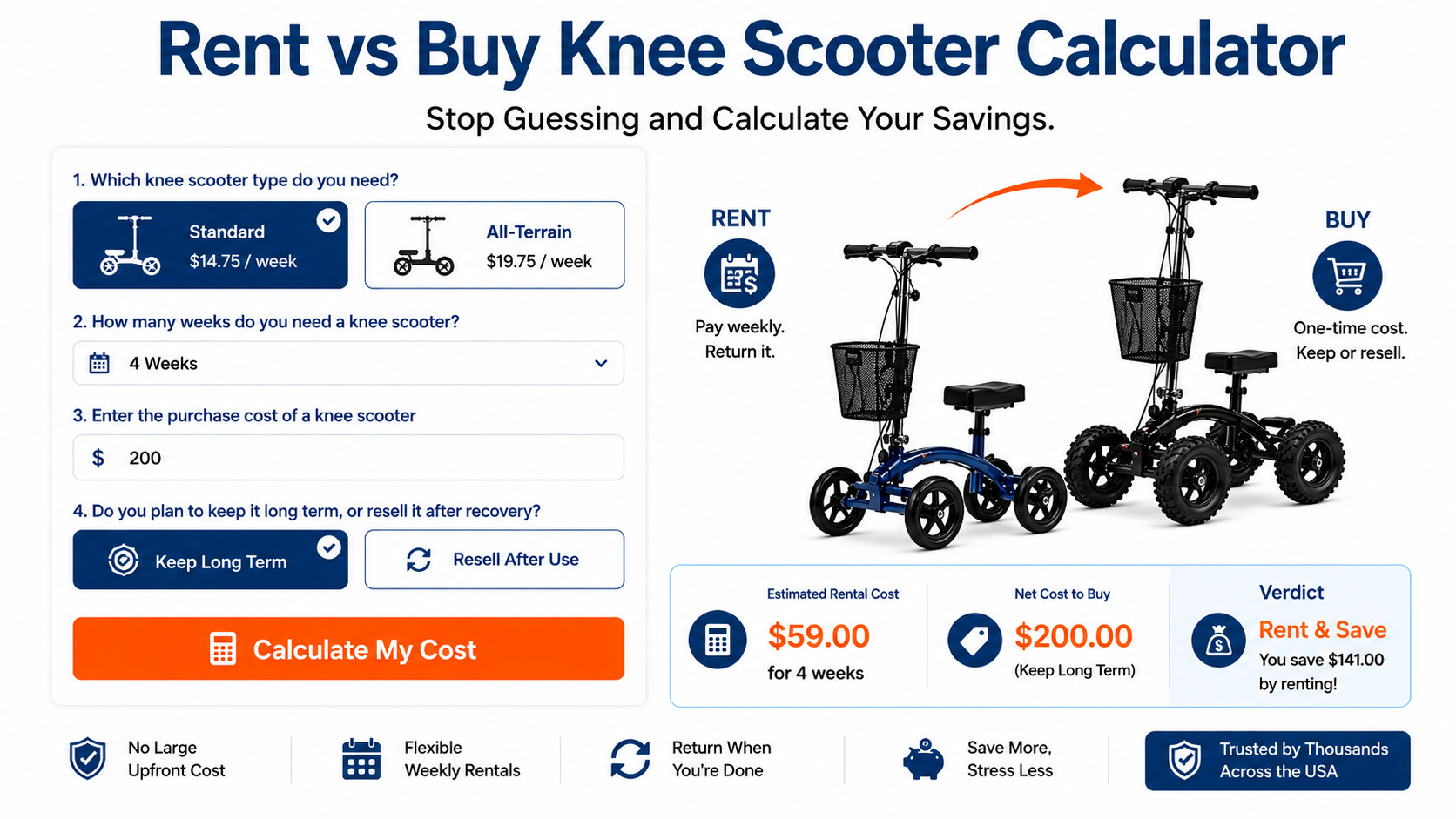
Standard models look sleek and low-profile, built for smooth indoor floors. All-terrain versions have thicker, air-filled tires, closer to a mountain bike’s, so they can handle grass, gravel, and light snow.
Most also have a small basket or storage pouch up front, which turns out to be more useful than it sounds when you’re trying to carry a coffee mug across the kitchen on one leg.
How Does a Knee Scooter Work?
A knee scooter works by shifting your body weight off your injured leg and onto the device instead of onto your hands and armpits.
Here’s the basic motion:
- Rest your injured leg on the padded knee platform, with your knee bent at about 90 degrees.
- Grip the handlebars and use the hand brakes to control your speed, exactly like a bike.
- Push off the ground with your good leg to move forward, and steer with the handlebars.
- Squeeze the brakes to slow down or stop, most models also have a parking brake for standing still.
The four-wheel base keeps you stable, so you’re not relying on balance and upper-body strength the way you would on crutches.
If you want a full walkthrough with photos, our guides on using a knee scooter with a boot or with a cast cover the exact setup step by step, and our instructions page has the quick-reference version.
When Would You Need a Knee Scooter?
Knee scooters are built for one specific situation: an injury to your foot, ankle, or lower leg that means you can’t put weight on it, but the rest of your leg is fine.
That covers a lot of common injuries, including:
- Ankle fractures and ankle surgery recovery
- Foot fractures and foot surgery recovery
- Severe ankle sprains
- Achilles tendon repairs and other lower-leg procedures
Standard vs. All-Terrain Knee Scooters
Not every knee scooter is built for the same environment, and picking the wrong one is a common regret.
Standard Models
They are designed for indoor use: hardwood, tile, carpet, and smooth, flat sidewalks. They’re lighter, more compact, and easier to maneuver in tight spaces like bathrooms and hallways.
All-terrain Models
They have larger, air-filled tires (typically 8–12 inches) that handle grass, dirt, gravel, and light snow, in addition to everything a standard model can do. If your daily routine involves anything outside a smooth floor – a driveway, a yard, an office parking lot – the extra traction is worth it.
Benefits of Using a Knee Scooter
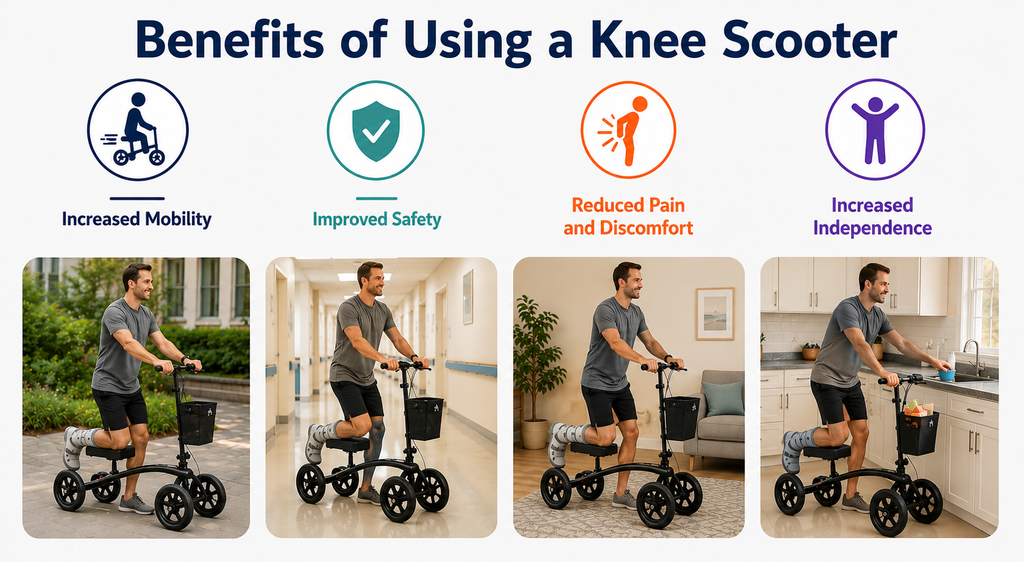
Increased Mobility
Crutches get tiring fast, and wheelchairs are bulky in tight spaces. A knee scooter splits the difference: lightweight, easy to steer, and fast enough that you can actually keep up with the rest of your household.
Improved Safety
This is the big one. Crutches put your stability in your hands and shoulders, which is a shakier foundation than it sounds.
A knee scooter’s four-wheel base removes a lot of that balance risk: see our full breakdown of whether knee scooters are safe to use for stability and fall prevention.
Reduced Pain and Discomfort
With crutches, your body weight concentrates on your hands and underarms, which is exactly why “crutch bruises” are a real, commonly reported thing. A knee scooter spreads that weight across your knee and the platform instead.
Increased Independence
You can carry a coffee, open doors, and move around your own house without asking someone to hover nearby in case you lose your balance. For a recovery that typically lasts 3–4 weeks, that independence matters more than it sounds like it would.
What to Look For When Choosing a Knee Scooter
- Weight Capacity: most standard models support up to 300 pounds; big & tall versions go up to 400. Confirm the limit before you commit to a specific scooter.
- Adjustability: Handlebar height and knee pad height should both adjust; this affects your posture and how comfortable multi-week use actually feels.
- Portability: If you’ll use it outside the house, look for a model that folds down and, ideally, comes with a basket for carrying essentials.
- Wheel Size: Standard models typically run 7–8 inch wheels; all-terrain models use roughly 12-inch pneumatic tires for better traction outdoors.
PRO TIP: Don’t just guess your fit. Our full knee scooter buyer’s checklist walks through sizing, terrain, and accessory options in more depth than we can cover here.
Is a Knee Scooter Right for You?
A knee scooter isn’t the answer for every lower-leg injury. If you can’t keep your other leg fully weight-bearing, or your injury is above the knee, talk to your doctor about a wheelchair or another option instead.
Knee scooters are just one entry in a much broader category of mobility aids, and our post on alternatives to crutches for knee and ankle injuries rounds up the other options if a knee scooter isn’t the right fit.
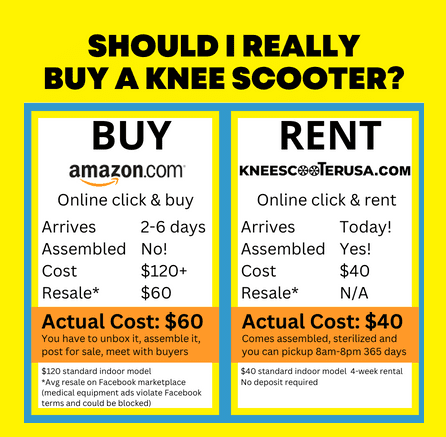
For most people recovering from an ankle fracture, foot surgery, or a bad sprain, though, a knee scooter is faster to get moving on, easier on your body, and, if you rent instead of buy, considerably cheaper than the alternative once shipping delays and resale losses are factored in.
Frequently Asked Questions About Knee Scooters
What does a knee scooter look like?
It looks like a small, low scooter with four wheels, a padded platform for your knee, and bicycle-style handlebars with hand brakes. Standard models are sleek and built for indoor floors; all-terrain models have thicker, air-filled tires for outdoor use.
What is a knee scooter used for?
It’s used to keep weight off an injured foot, ankle, or lower leg, most commonly after an ankle fracture, ankle surgery, foot fracture, foot surgery, or a severe ankle sprain – while still letting you move around independently.
How does a knee scooter work?
You rest your injured leg on the padded platform with your knee bent, then push off with your good leg and steer using the handlebars, braking the same way you would on a bike. The four-wheel base does the balancing for you.
Is a knee scooter better than crutches?
For most lower-leg injuries, yes. It’s easier on your hands, wrists, and underarms, and the four-wheel base makes it harder to lose your balance than crutches do. See our full knee scooter pros and cons breakdown for the honest tradeoffs. It’s not perfect for every situation, but for most people it beats crutches by a wide margin.