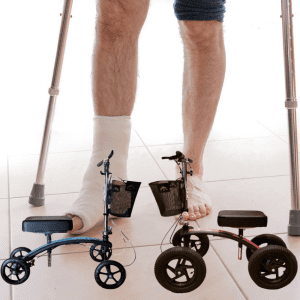
Medicare covers wheelchairs and walkers. That’s why many patients recovering from an ankle fracture, foot surgery, or a bad sprain, assume that it covers knee scooters, too.
However, it doesn’t and that catches most people off guard right when they’ve been told to stay off their feet for a few weeks. Here’s why, and what your real options are.
Original Medicare Doesn’t Cover Knee Scooters
Original Medicare classifies knee scooters as a crutch substitute, not as durable medical equipment (DME) that qualifies for reimbursement.
Medicare’s DME benefit, under Part B, is built around a specific list of devices it considers medically necessary: standard walkers, rolling walkers, canes, crutches, manual wheelchairs, and power scooters or wheelchairs that meet strict criteria.
Knee scooters, also called knee walkers, sit in a gap. They aren’t power mobility devices, since they aren’t motorized. They also aren’t on the basic list Medicare approves automatically, like crutches or a walker.
So when you ask “does Medicare cover knee scooters?,” the answer under Original Medicare is no, Medicare considers them “not reasonable and necessary” when a covered alternative already exists for the same injury.
This applies whether you want to rent or buy. Original Medicare simply doesn’t reimburse the device.
Why Medicare Draws the Line Here
It helps to understand the logic, even when it’s frustrating at the moment. Medicare’s DME decisions follow a “least costly alternative” principle.
If a cheaper, covered device can reasonably meet the same medical need, Medicare points to that option instead of approving a pricier or less conventional one.
For a non-weight-bearing ankle or foot injury, Medicare’s position is that crutches or a walker already solve the mobility problem.

The fact that a knee scooter is often more comfortable, easier on the upper body, or a better fit for someone with limited arm strength doesn’t enter the formula. Comfort and ease of use aren’t part of the “medically necessary” test the way they arguably should be.
This is also why power scooters and power wheelchairs get different treatment. Those go through prior authorization, a face-to-face exam, and a written order, and once approved, Part B pays 80% after the deductible.
A knee scooter never reaches that conversation, because it’s excluded before the process even starts.
There’s a second layer worth understanding. Medicare’s DME coverage is tied to use inside the home. A device has to be needed for daily activities within your home to qualify at all, outdoor-only or convenience use doesn’t count.
Knee scooters fail on a different point entirely (the crutch-substitute classification), but this home-use rule is why even the covered devices come with strings attached, and why a quick, short-term recovery aid rarely fits Medicare’s framework cleanly.
What Medicare Does Cover for Mobility After an Injury
Knowing what is covered clarifies your real options, even if none feel like the obvious choice for a three-to-four-week ankle recovery.
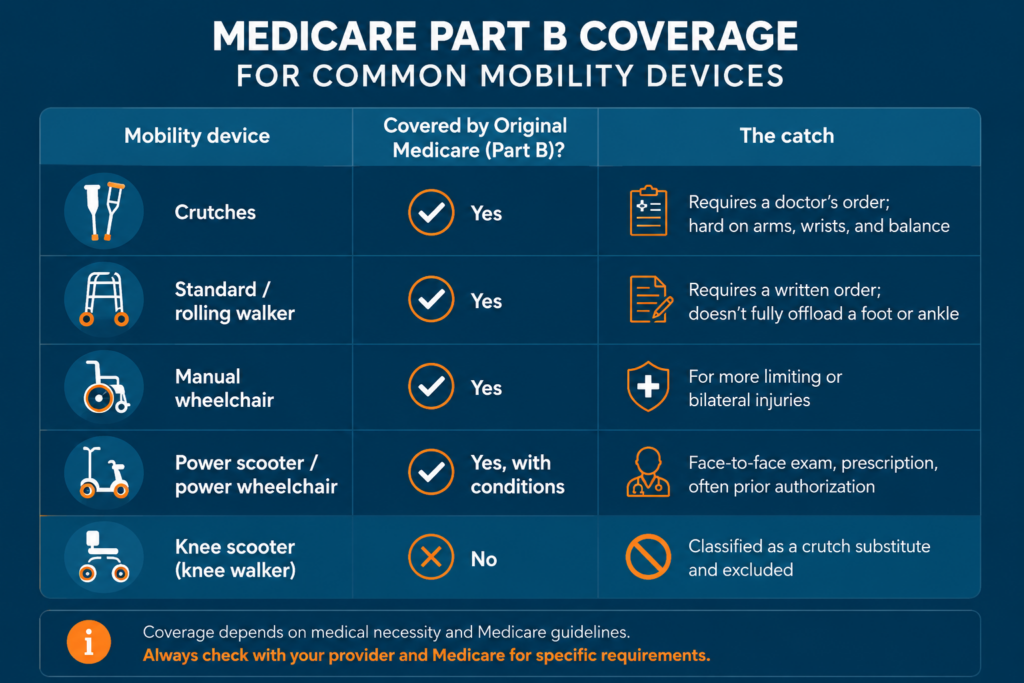
Notice what’s missing from the covered list. None of these are knee scooters. So if a doctor or supplier brings up “insurance” for a knee scooter, ask directly whether they mean Original Medicare, because the answer for Medicare Advantage works differently.
You can dig into the broader insurance picture in our guide on whether insurance covers a knee scooter rental.
Where Medicare Advantage Plans Change the Picture
Medicare Advantage (Part C) plans must cover, at minimum, everything Original Medicare covers. But many go further with supplemental benefits Original Medicare doesn’t touch and a knee scooter can sometimes fall into that category.
Whether yours does comes down entirely to your specific plan. Some Advantage plans include allowances for over-the-counter mobility aids, supplemental DME benefits, or flexible-spending cards usable toward equipment like a knee scooter.
Others stick close to Original Medicare’s list and exclude them the same way.
If you’re on an Advantage plan, the only reliable way to know is to call your plan directly and ask whether knee walkers fall under any supplemental benefit, and what documentation they’d need from your doctor.
Roughly half of all Medicare beneficiaries are now enrolled in Medicare Advantage plans, which means for a large share of people, the knee scooter answer isn’t a flat “no.” It’s “check your specific plan.”
Ask These 3 Questions Before You Count on Reimbursement
Sometimes suppliers and even some clinic staff tell you, “We’ll give you a receipt you can submit,” but that is different from “Medicare-covered”. Before you count on reimbursement, ask these three questions:
- Original Medicare or Medicare Advantage? Original Medicare won’t cover the scooter. Advantage might, through a supplemental benefit. Know which one you’re dealing with.
- Is this reimbursement or a guarantee? A receipt with HCPCS codes lets you try to get money back. It’s not a promise the claim will be paid.
- Is the supplier Medicare-enrolled? Coverage of any kind requires an enrolled supplier that accepts assignment. If they aren’t enrolled, even a covered device isn’t reimbursable.
Getting clear answers up front saves you from budgeting around money that may never arrive.
What This Means for Your Wallet
You have to pay for the knee scooter if Medicare doesn’t cover it. In this situation, the buy-versus-rent math matters.

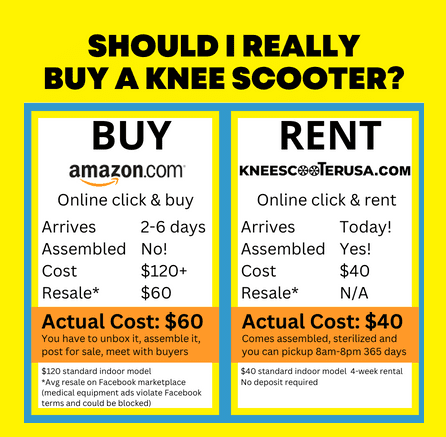
Buying one online usually means a two-to-three-day shipping wait and then assembly while you’re injured.
Most people only need the device for three to four weeks. When recovery’s over, reselling is harder than expected.
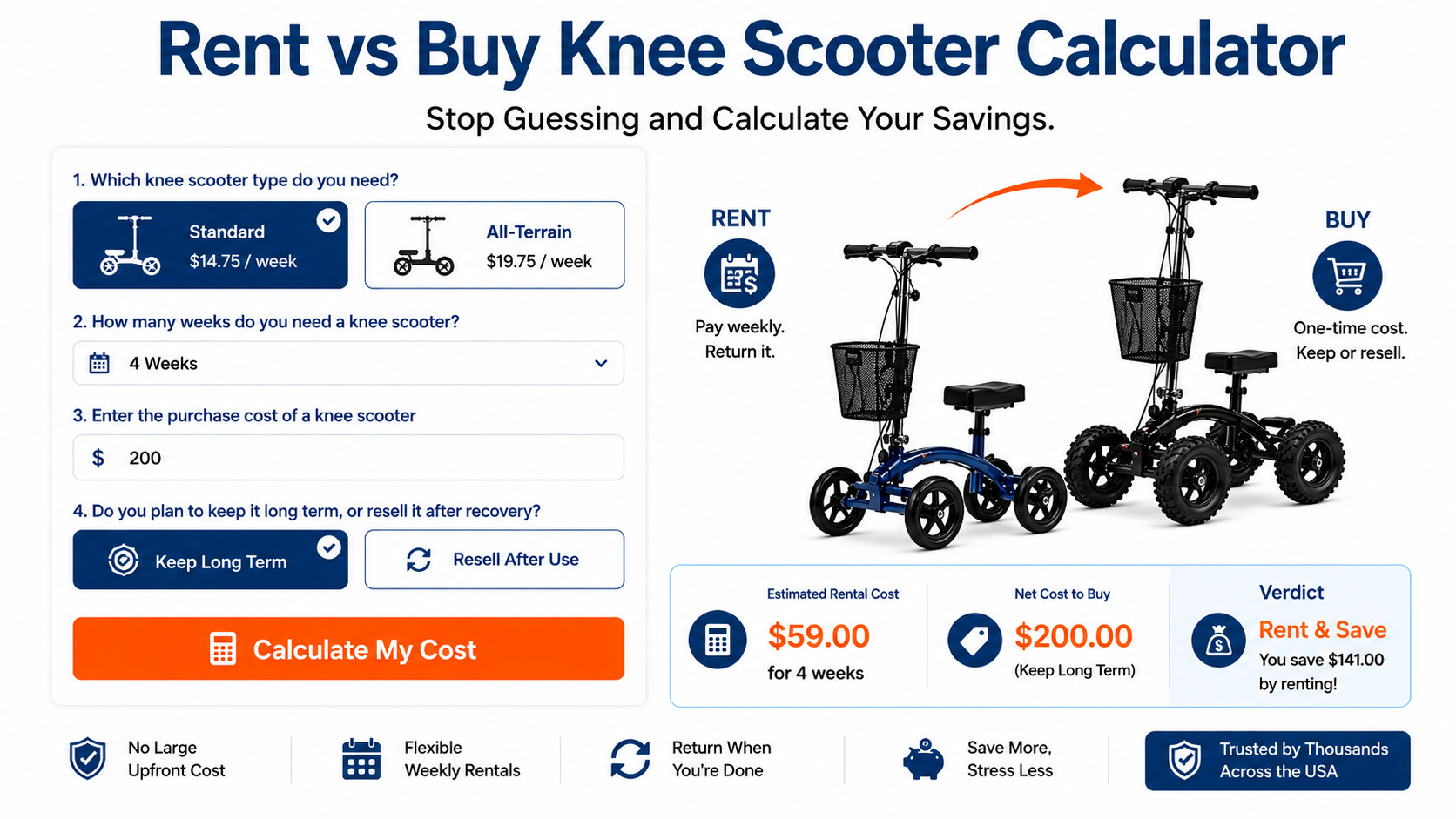
When you rent, you pay for the weeks you actually use, and then return the scooter. Additionally, you skip the assembly and resale headache.
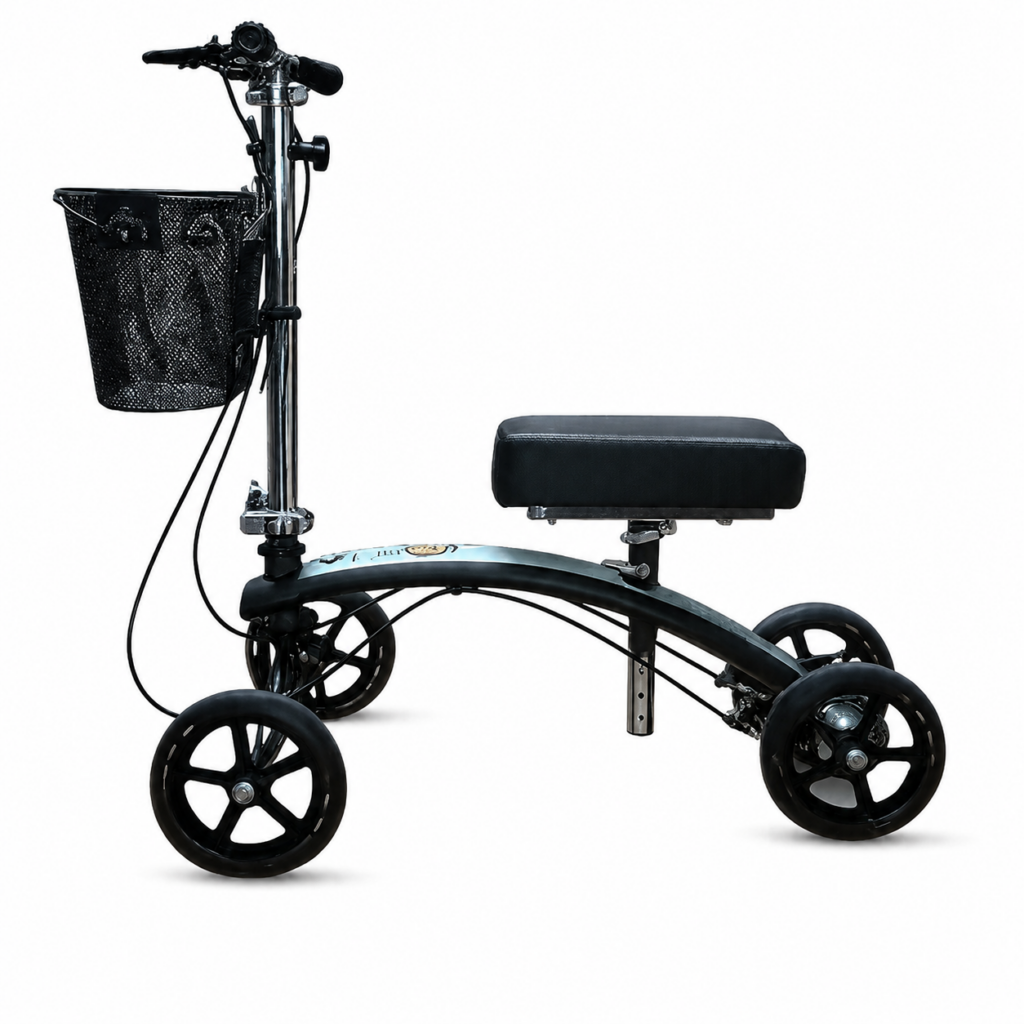
At $14.75 a week for the Standard model, a typical four-week non-weight-bearing recovery runs well under what most people expect to spend buying new, before you even factor in the lost resale value. If you want the numbers on your exact timeline, the rental cost calculator does the math in seconds.
Don’t forget to ask your supplier for an itemized receipt with HCPCS codes when you return it, even though Medicare won’t cover the device, because some Medicare Advantage plans, supplemental policies, and FSA/HSA accounts will reimburse part of the cost if you submit the right paperwork.
Other Mobility Options Worth Knowing About
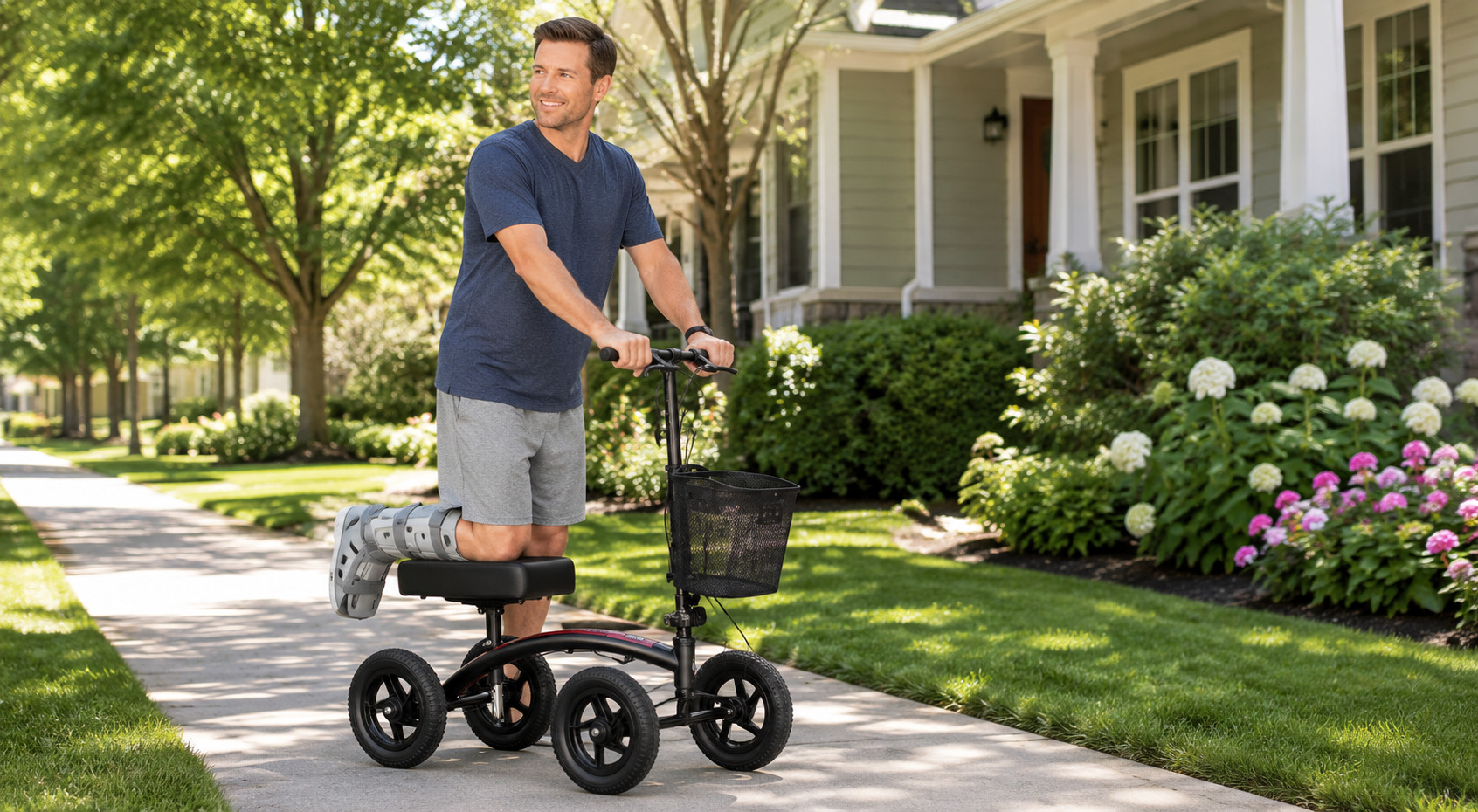
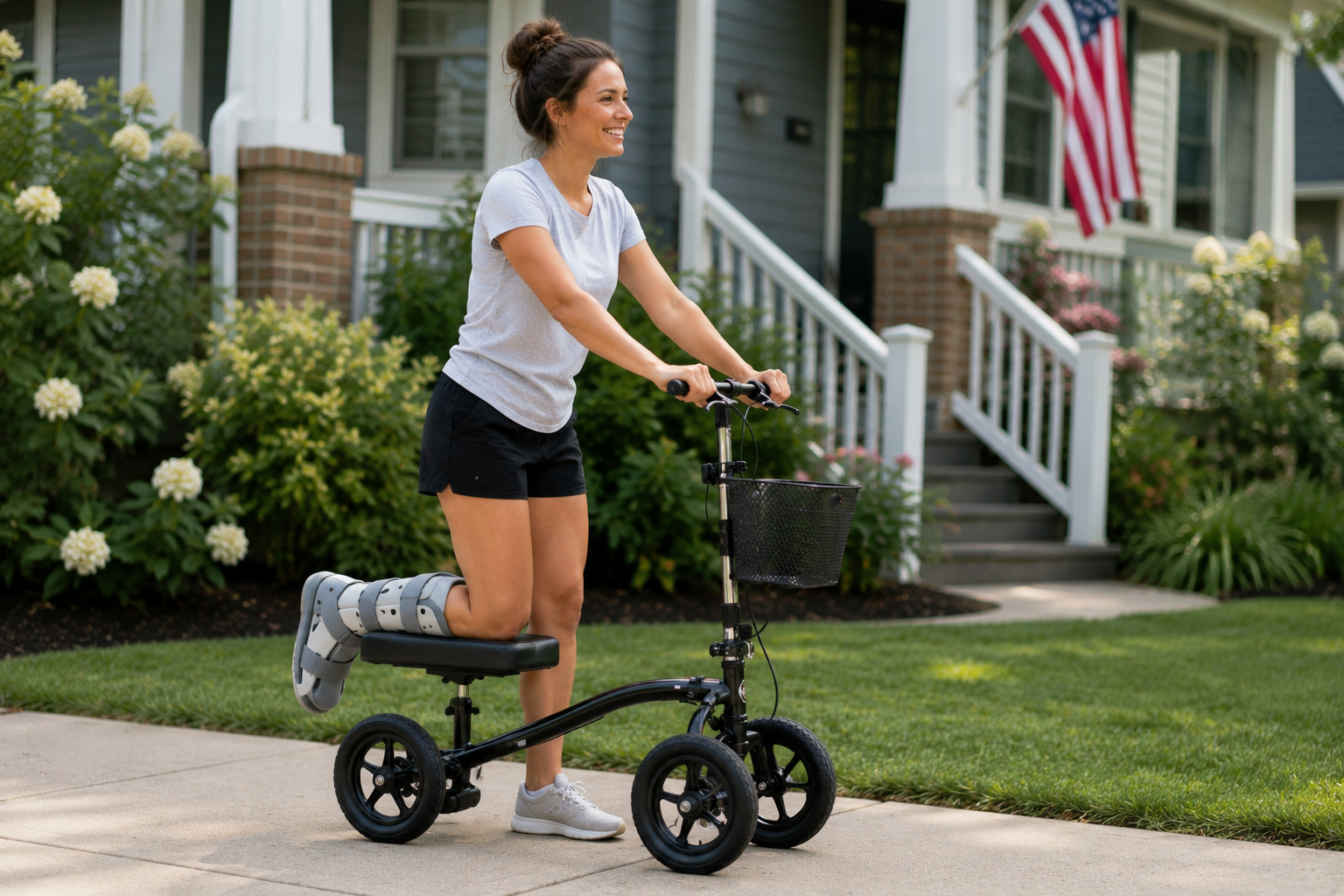
A knee scooter isn’t the only choice outside Medicare’s covered list, and it isn’t always the right fit. The standard model works best for indoor recovery, sidewalks, and most ankle or foot injuries where the knee joint itself is healthy.
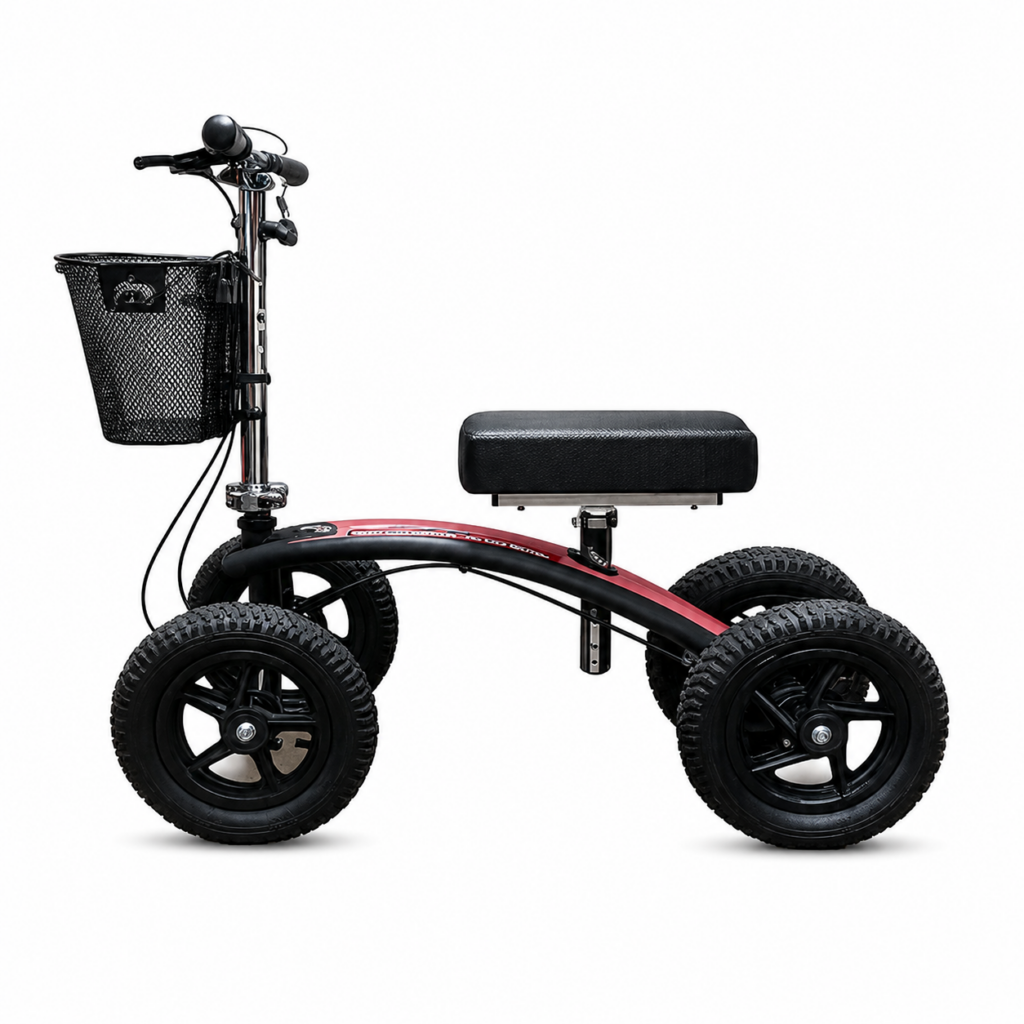
The all-terrain version, with larger air-filled tires, suits anyone who needs to keep walking the dog, traveling, or crossing uneven ground during recovery.
If the injury is to the knee itself rather than the ankle or foot, a knee scooter isn’t the right device at all, the platform relies on a healthy knee to bear weight.
There, a walker or wheelchair (both Medicare-covered) becomes the sensible option regardless of cost.
For most people facing a three-to-four-week recovery, renting locally is the simplest, most affordable path: no waiting, no assembly, no resale problem. Find your nearest pickup location and get moving again, often within minutes of booking.