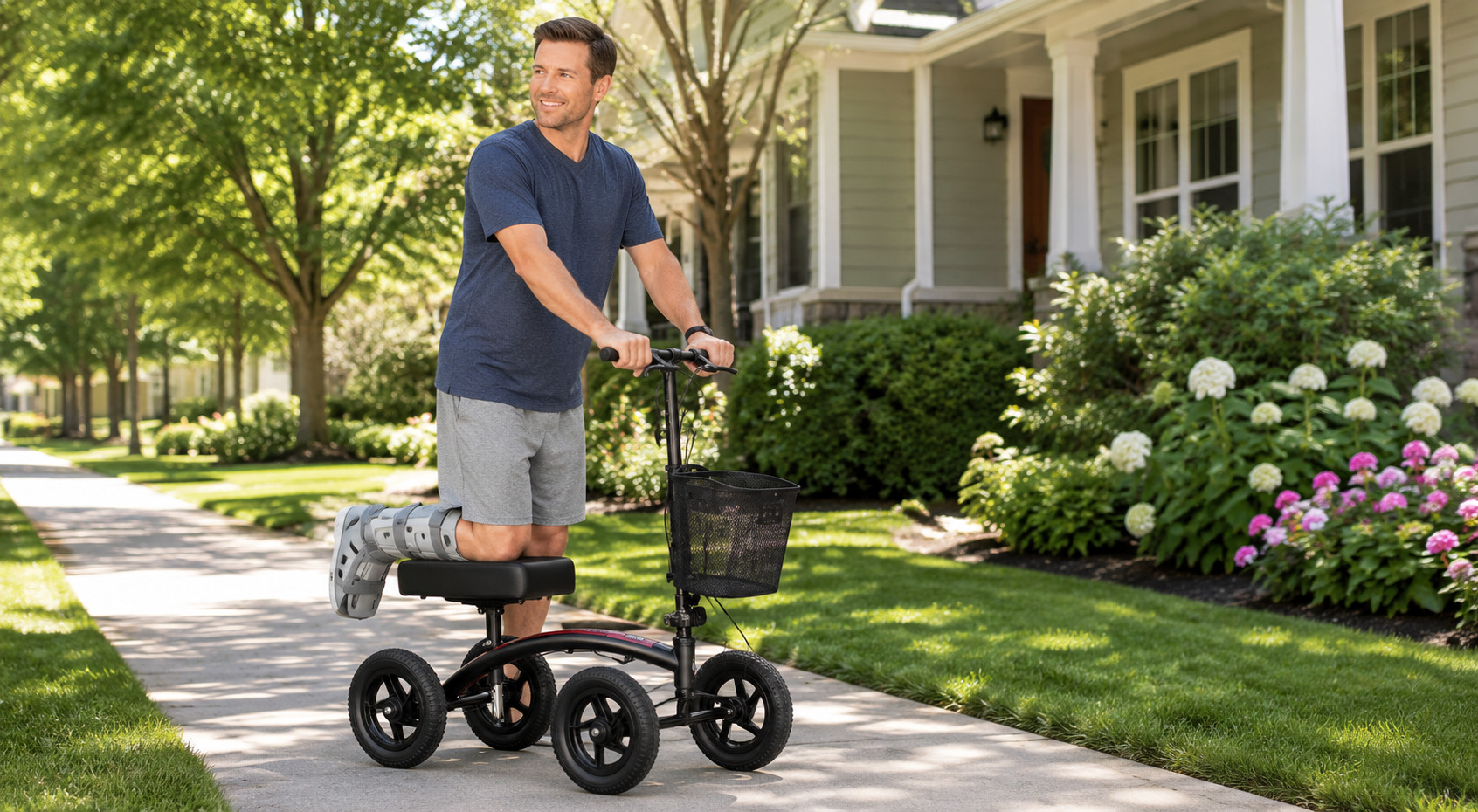
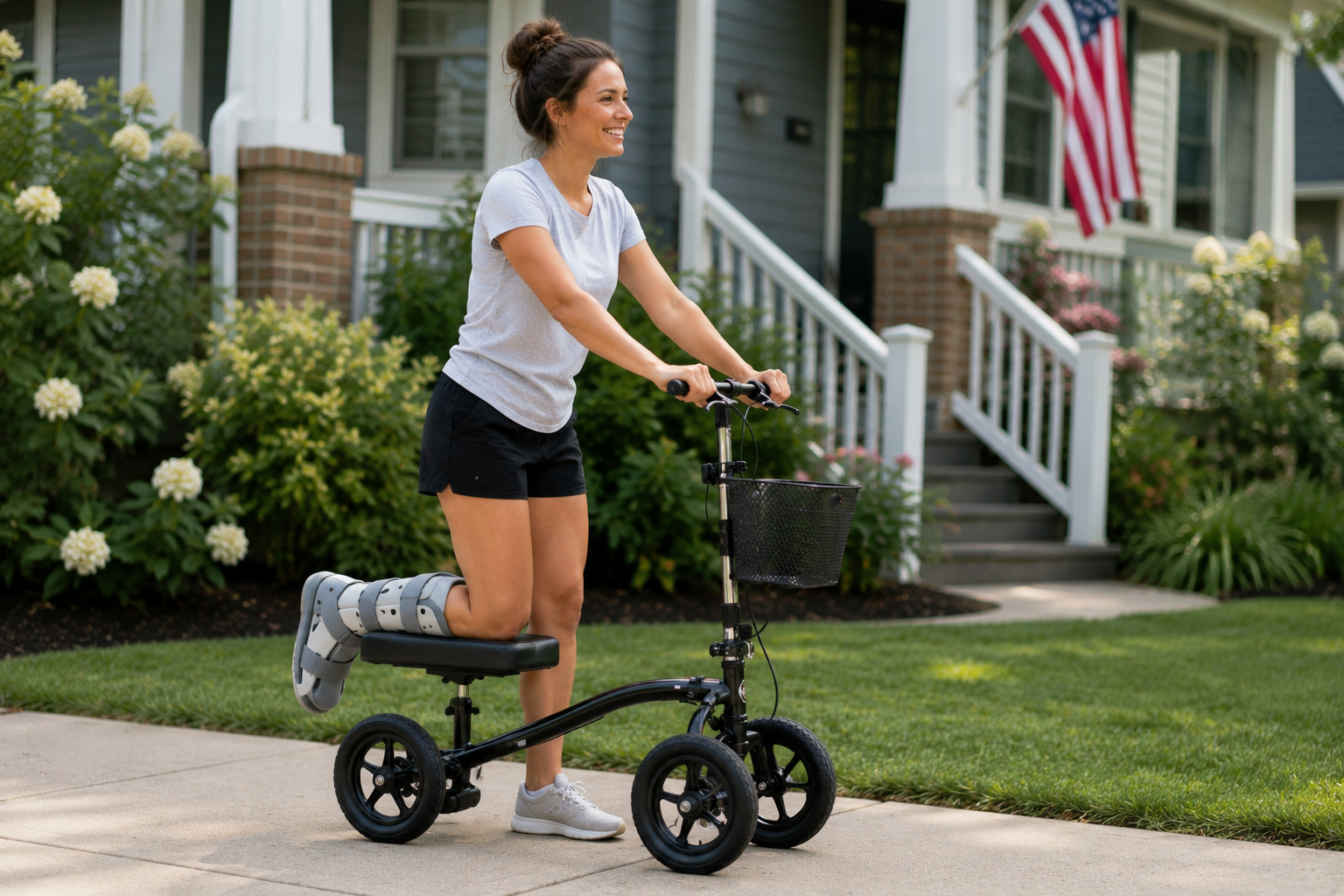
Not long ago, most people recovering from a foot or ankle injury had one option: crutches. Today, knee scooters are everywhere, from orthopedic clinics to neighborhood sidewalks, and for good reason.
Still, one concern hasn’t changed: Are knee scooters safe for everyday use? Before you trust one with your recovery, it’s worth understanding where the real risks come from and what actually keeps riders safe.
Knee Scooter Safety: What You Need to Know Before You Ride
Getting back on your feet, literally, starts with equipment you can actually trust. A knee scooter is one of the easiest ways to stay mobile while you heal, and most riders feel comfortable on one within their first few minutes of use.
Here’s exactly what makes a knee scooter safe, so you can roll out the door with confidence instead of second-guessing every push.
The Verdict: Why Knee Scooters Are Built to Be Safe
A knee scooter isn’t a gamble. It’s a stable, four-wheeled piece of equipment designed specifically to keep weight off a healing foot or ankle while you get around on your own.
Set up right, it’s an easy way to stay independent through recovery, and many riders find it far more manageable than balancing on crutches, since it doesn’t demand upper-body strength or one-legged stability.
- Built for ankle fractures, ankle surgery recovery, foot fractures, foot surgery recovery, and ankle sprains
- Keeps all your weight off the injured leg instead of asking you to balance on it
- Doesn’t rely on arm strength or stamina the way crutches do
Bottom line: The injury types this device is made for are exactly the injuries it handles safely, day in and day out.
Three Checks That Make or Break Your Safety
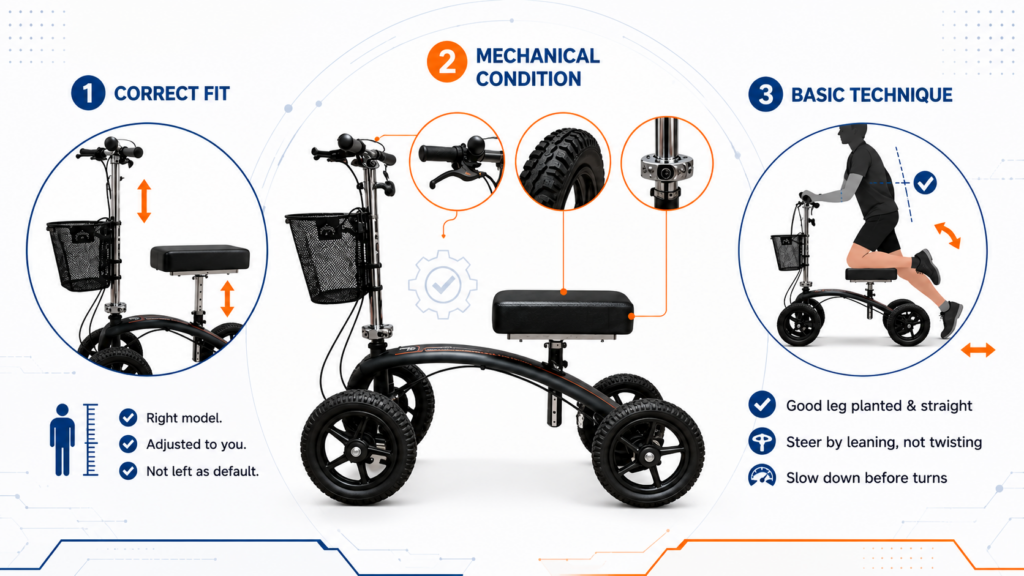
Safety isn’t one big factor. It comes down to three smaller ones, and they’re all things you can actually check. Get these right, and you’ve handled almost every risk before you even start moving.
- Correct fit: The right model for your height; Standard fits 4’9″ to 6’6″, All-Terrain fits 5’0″ to 6’6″, both up to 350 lbs, with the knee pad and handlebars adjusted to you, not left at some default setting
- Mechanical condition: Brakes that actually grip, tires with tread left, nothing loose or rattling; not a scooter that’s been sitting untouched in a garage for a few years
- Basic technique: Good leg planted and straight, steering by leaning instead of twisting the handlebars, slowing down before turns; we’ll walk through this step by step further down
Think of it like a car. A well-maintained car in the right hands is safe. The same car with bald tires and a driver who’s never adjusted the seat? Different story entirely.
Spot the Risks Before They Become a Fall
Here’s the thing people get wrong: the device itself is rarely the problem. Falls and near-misses almost always trace back to something outside the scooter’s design.
- Ill-fitting equipment, like a knee pad set too low or handlebars too far from the rider’s grip
- Worn brakes or soft tires on a scooter that’s been sitting unused for a long stretch
- Using a scooter somewhere it was never meant to go, like stairs or a steep ramp
None of these are flaws in the scooter. They’re maintenance and setup issues, and both are fixable before you ever start rolling.
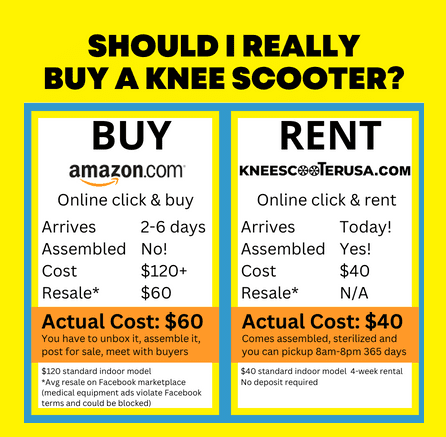
Why Renting Beats Buying on Safety Alone
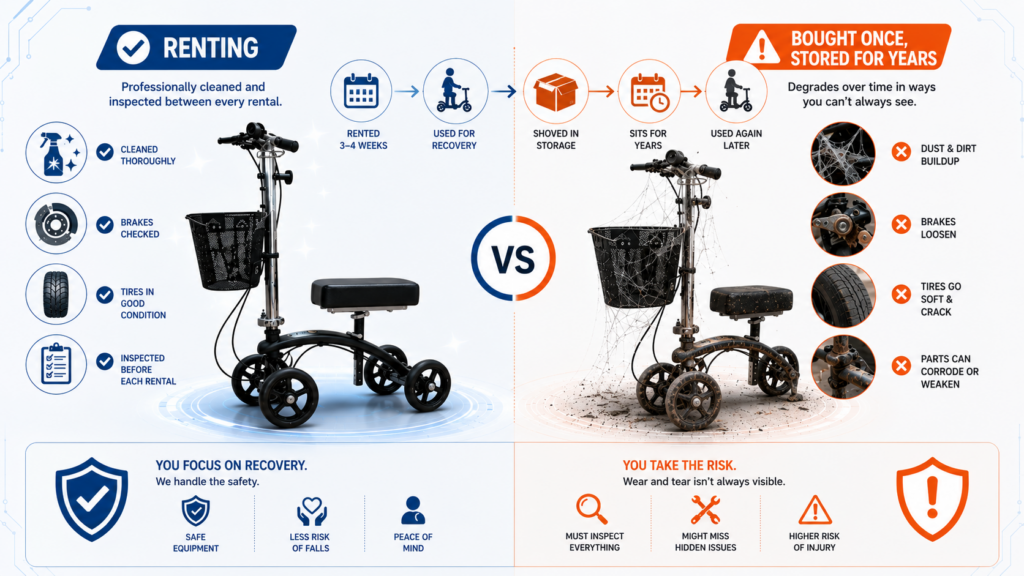
This is the part most people don’t think about until it’s too late. Every scooter we rent out is cleaned and inspected between rentals, so it starts your rental in good working order every single time.
Compare that to a scooter someone bought once, used for their standard 3 to 4 week recovery, then shoved in a closet for a couple years before trying to sell it. Tires go soft. Brakes loosen. Nobody’s checking that scooter before the next person hops on it.
- Every rental scooter is cleaned and inspected between renters
- A scooter bought and stored for years degrades in exactly the ways that cause falls, soft tires, and loose brakes
- You’re not the one responsible for catching wear and tear on equipment you’ll only use once or twice in your life
Pro tip: If you already own a knee scooter that’s been sitting for a while, don’t assume it’s ready to go. Check the brakes and tires before you trust your weight to it.
Fit, condition, and technique are the whole safety equation. Get those three right, and a knee scooter is exactly as safe as it’s designed to be.
Pre-Ride Check: The 60-Second Routine That Prevents Falls
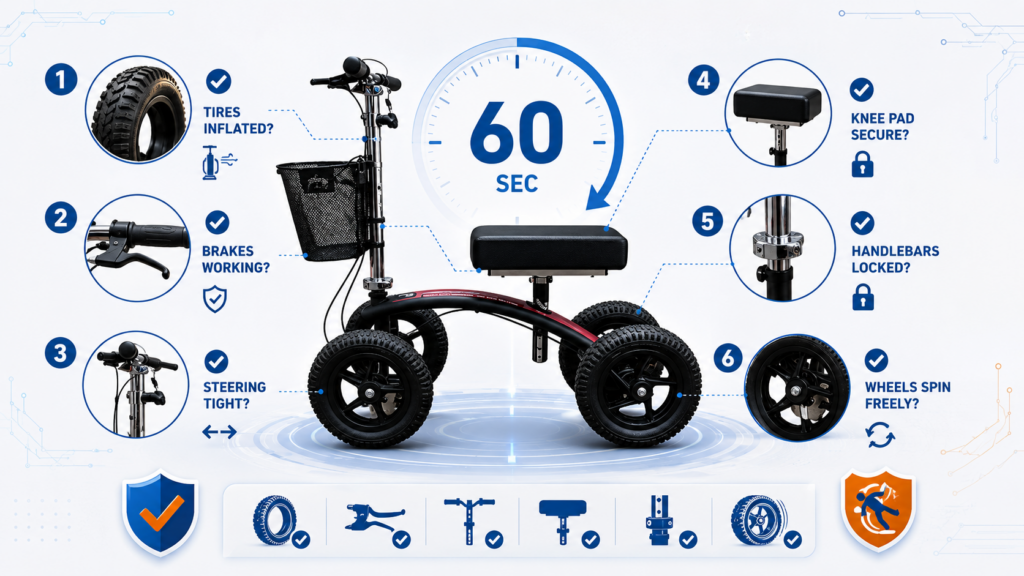
Pilots don’t skip the pre-flight checklist, no matter how many times they’ve flown. The same idea applies here. Sixty seconds before you push off can be the difference between a smooth ride and a hard landing on the exact leg you’re trying to protect.
- Tires inflated? Air-filled tires (the All-Terrain’s 12-inchers) go soft over time, even sitting unused. A soft tire throws off your balance before you’ve even started moving.
- Brakes working? Squeeze the lever. It should grip fast and hold, not travel halfway to the handlebar before doing anything.
- Steering tight? Turn the handlebars left, then right. Any wobble or looseness there means something’s not locked down right.
- Knee pad secure? Give it a push. It shouldn’t shift, slide, or rock once your knee’s on it. A loose pad is one of the fastest ways to lose your balance mid-push.
- Handlebars locked? Confirm the height adjustment is actually clicked into place, not just resting there. A handlebar that drops mid-ride catches most people off guard.
- Wheels spinning freely? Give each one a spin by hand. Catching, grinding, or dragging means debris or wear is already working against you.
None of this takes more than a minute once it’s a habit. Skip it once, and you probably won’t notice the difference. Skip it for weeks on a scooter that’s been sitting in a garage, and the odds catch up eventually.
Pro tip: Run through this same six-point check every time you pick up a rental, not just the first day. A scooter that passed the check on Monday can pick up a soft tire or a loose bolt by Thursday, especially with daily use.
For anyone renting through us, this list is mostly a formality. Every scooter gets cleaned and inspected between rentals, so you’re starting from a scooter that’s already passed this exact check before it ever reaches you. Still worth the sixty seconds, though. It’s your leg on the line, not ours.
Know the Limits: When a Knee Scooter Isn’t the Right Fit
A knee scooter solves one problem. One bad leg, one good leg, and weight that needs to stay off the injured side. Change that setup and the whole thing stops making sense. A few situations call for something else entirely.
Both Legs Injured? The Math Doesn’t Work
Here’s the thing. The design only works because one leg is healthy enough to push and hold you steady while the other one rests. Take that away, and there’s nothing left to stand on. Not figuratively, either.
- No leg free to bear weight while you steer or stop
- Pushing off? Not happening without a good foot on the ground
- Balance rides entirely on that one healthy leg, every push, every stop
Example: a broken ankle on one side and a fractured foot on the other isn’t a knee scooter situation. Doesn’t matter how well it fits your height and weight otherwise.
A Painful Supporting Knee Changes Everything
The leg you kneel on carries real weight, for hours, not minutes. That’s a lot to ask of a knee that’s already struggling.
- Arthritis or chronic pain in that knee? Sustained kneeling gets genuinely painful, fast
- An old injury can flare right back up under constant pressure
- A knee that can’t bear weight comfortably turns the fix into a whole second problem
Heads up: if your “good” knee already bothers you on an ordinary day, weeks on a scooter won’t be kind to it.
Balance or Vertigo Raises the Stakes
Riding one of these takes steady footing and a clear head. You’re steering, braking, dodging furniture and thresholds and other people. Sounds simple until balance is already an issue.
- Vertigo or dizziness makes steering unreliable, plain and simple
- Had a fall recently? That risk hasn’t gone anywhere
- Wheels under one leg raise the stakes for someone who’s already unsteady, not lower them
Pro tip: A fall or a dizzy spell in the last month is worth mentioning before anyone hands you a scooter.
Injuries Above the Knee Need a Different Fix
A knee scooter works by resting weight on the knee itself. That only helps if the injury is below it.
- Hip injuries? Not addressed by a device built around the knee
- Same goes for upper-leg or thigh injuries, outside what the pad is meant to protect
- Resting an above-the-knee injury on this thing doesn’t take weight off where it actually hurts
Example: a hip fracture needs a completely different mobility aid, even if someone fits the height and weight range perfectly.
None of this means mobility is off the table. It just means a knee scooter probably isn’t the right tool here, and something like a walker, wheelchair, or a device built for your specific injury makes more sense instead. That call isn’t yours to make alone.
Your surgeon or physical therapist knows the injury, the surgical plan, and your overall condition well enough to say which mobility aid actually fits, and that’s who should have the final word here.
Safe Recovery Starts With The Right Choices
Knee scooters are safe when three things line up: the right fit, equipment in good shape, and technique that respects how the device works.
A sixty-second check before every ride catches most of what causes falls, and knowing when to skip one entirely – bilateral injuries, a bad knee, balance issues – matters just as much as knowing how to ride one.
None of that happens by accident. At Knee Scooter USA, every scooter we hand you is already cleaned, inspected, and ready in five minutes, not one that’s sat untouched in a garage for years.
Pick your model, pick your location, and start recovery on equipment you don’t have to second-guess.