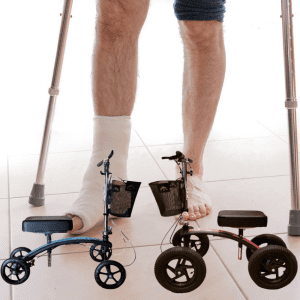
You leave the doctor’s office with a diagnosis of a broken foot, a boot, and strict instructions not to put any weight on that foot for the next six to eight weeks.
Crutches are usually the default answer.
They’re also the answer that almost nobody is happy with after a couple of days. Crutches cause sore armpits, wrecked wrists, and you can even carry a coffee cup because both hands are busy keeping you upright. A simple trip to the bathroom turns into a real adventure.
So people end up asking whether a scooter can replace crutches for a broken foot. The short answer is yes, for most foot fractures, a knee scooter is not just usable, it’s the better option.
The Real Problem with Using Crutches for Foot Fractures
Doctors hand out standard aluminum crutches by default because they are cheap and easy to keep in a clinic closet. However, they weren’t designed specifically for foot or ankle injuries – they were designed as a one-size-fits-all tool for total leg trauma. So, maybe you should be considering crutch alternatives for ankle injuries.
When you are dealing with a 6-to-8-week non-weight-bearing window for a broken foot, traditional crutches quickly expose three major flaws:
- Upper-Body Strain: Crutches force your wrists, hands, and shoulders to carry your entire body weight. By week two, it is incredibly common to develop sore palms, aching shoulders, and nerve tingling in your hands.
- The “Two-Hands-Tied” Problem: Because both hands are completely occupied keeping you upright, you lose your independence. You can’t carry a cup of coffee, carry a laptop, or open a heavy door on your own.
- Higher Fall Risks: Hopping on an uninjured foot while swinging your upper body forward is inherently unstable. One slick tile or uneven sidewalk crack can lead to a slip, risking a secondary injury to your healing foot.
How a Knee Scooter Helps With a Broken Foot
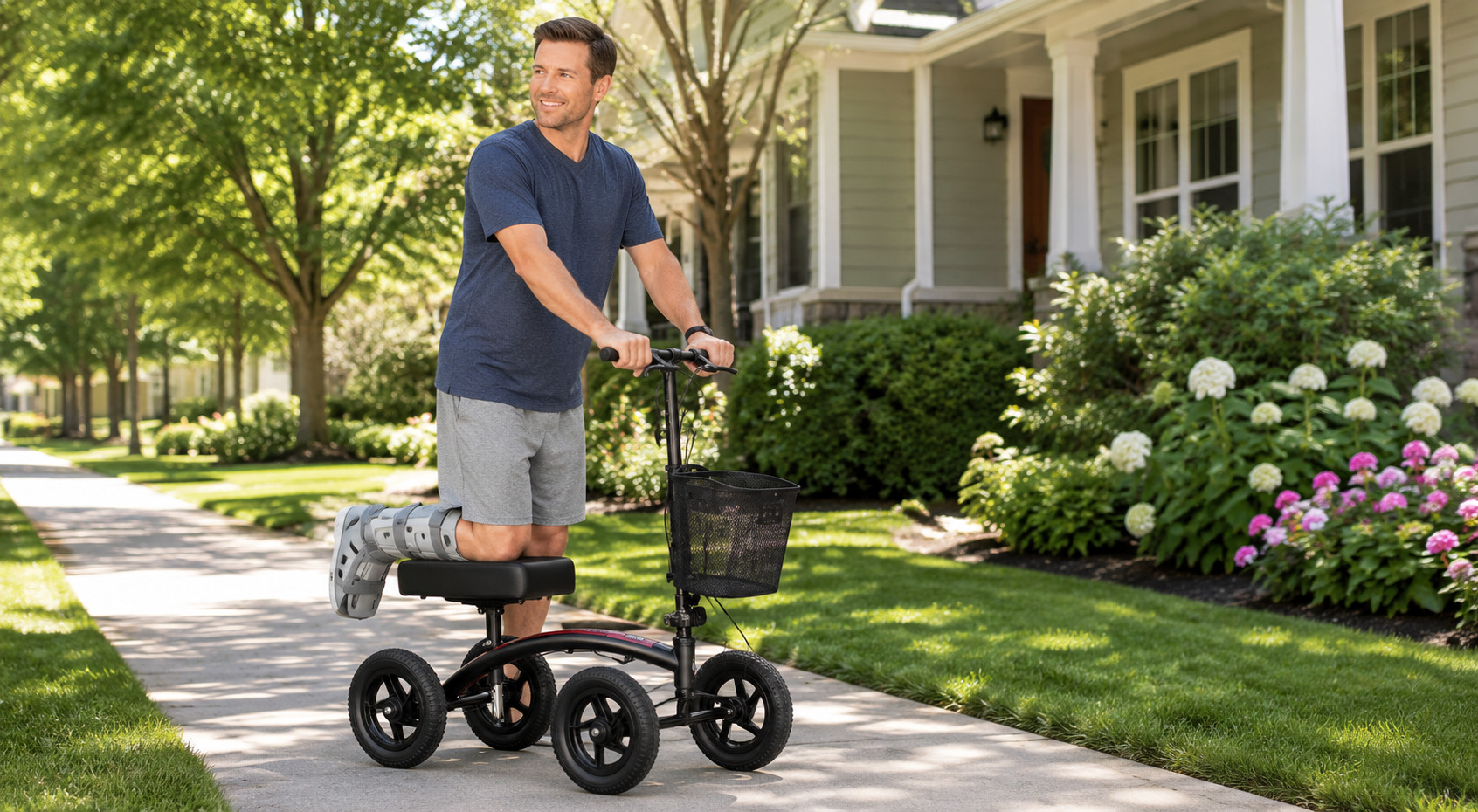
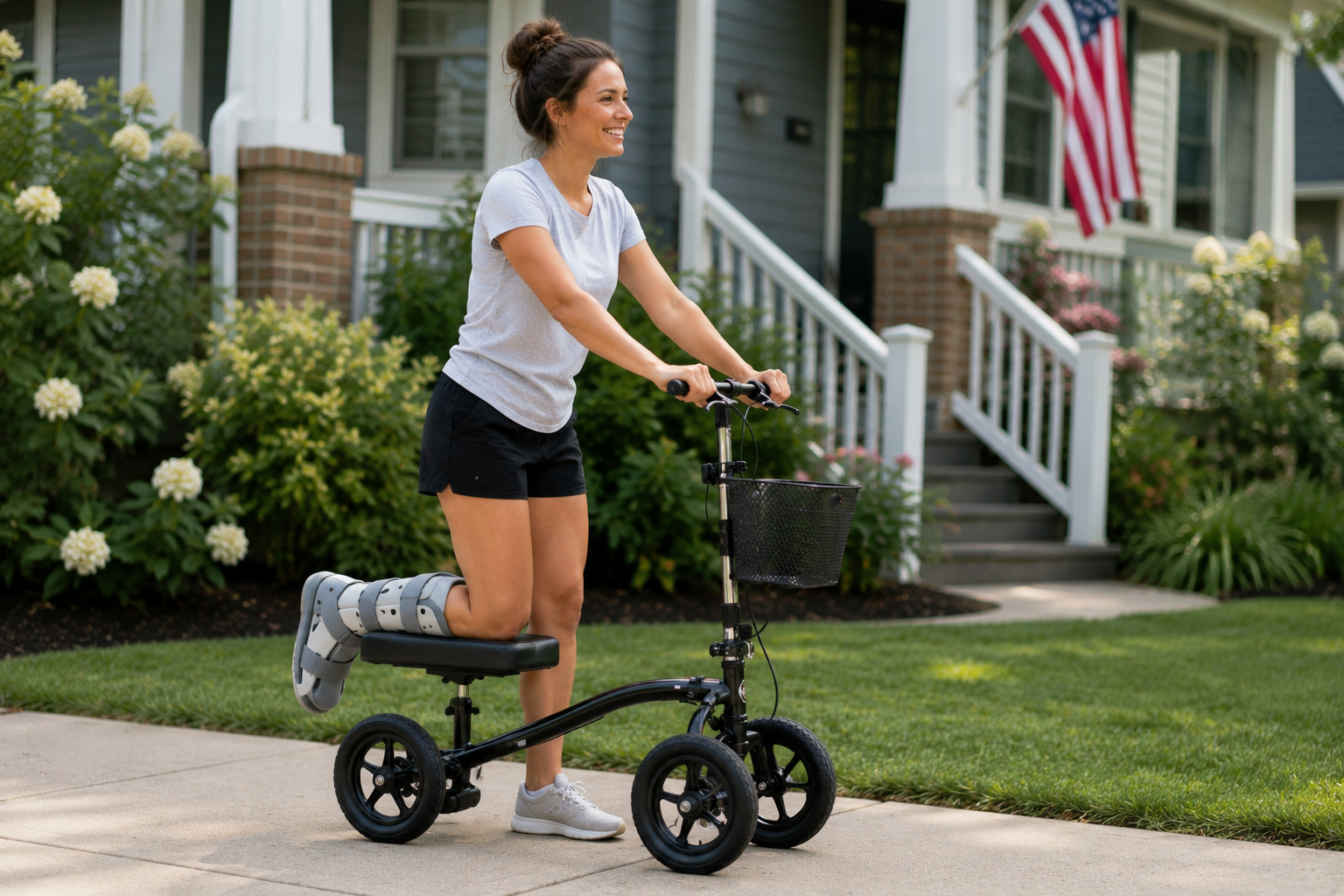
A knee scooter bypasses these issues by shifting the physical workload from your upper body back down to your legs, which are actually built to carry weight. Your injured leg rests safely bent at a 90-degree angle on a thick, contoured foam platform, completely isolated from the ground so the bone can knit back together cleanly.
At Knee Scooter USA, we see thousands of patients make this exact switch within their first week of injury. Trading the clumsy swing-and-hop of crutches for a wheeled device completely changes your daily routine:
- Regain Your Hands: Because you can coast or lock the brakes, your hands remain free to do normal tasks. Plus, adding a handlebar basket lets you transport items around the house without asking for help.
- Move at Walking Speed: Instead of an exhausting, slow shuffle, you can roll at a natural walking pace using your healthy leg to push.
- Protect Your Posture: Crutches force you to slouch forward and twist your spine. A knee scooter keeps your hips aligned and your back straight, preventing the classic “compensating pain” in your lower back.
Where we operate:
- Arizona: Phoenix, Tucson
- California: Sacramento, San Jose
- Colorado: Colorado Springs, Denver, Fort Collins, Wheat Ridge
- New Mexico: Albuquerque
- South Carolina: Greenville
- Texas: Austin, Arlington
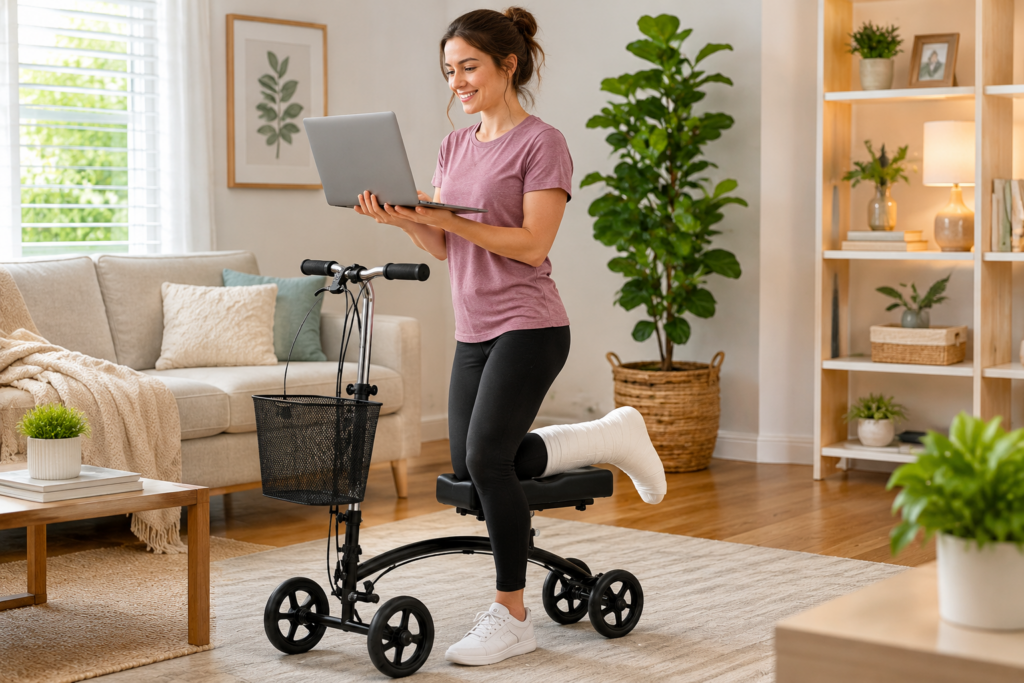
To use a knee scooter, your knee must be healthy. The entire design relies on your uninjured leg’s knee carrying your body weight on that padded platform for hours at a stretch.
If the knee on your good leg has arthritis, an old injury, or just doesn’t tolerate sustained bent-knee pressure well, a standard scooter will fight you instead of helping you.
In that case, a seated knee scooter or a rollator is a better option, and it’s worth discussing with your orthopedist before you commit to one device.
Standard or All-Terrain: Picking the Right Model
Once a knee scooter is confirmed as the right tool, the next decision is simpler than it looks. Two models exist (standard vs. all-terrain), and the choice mostly comes down to where you’ll actually be using it.
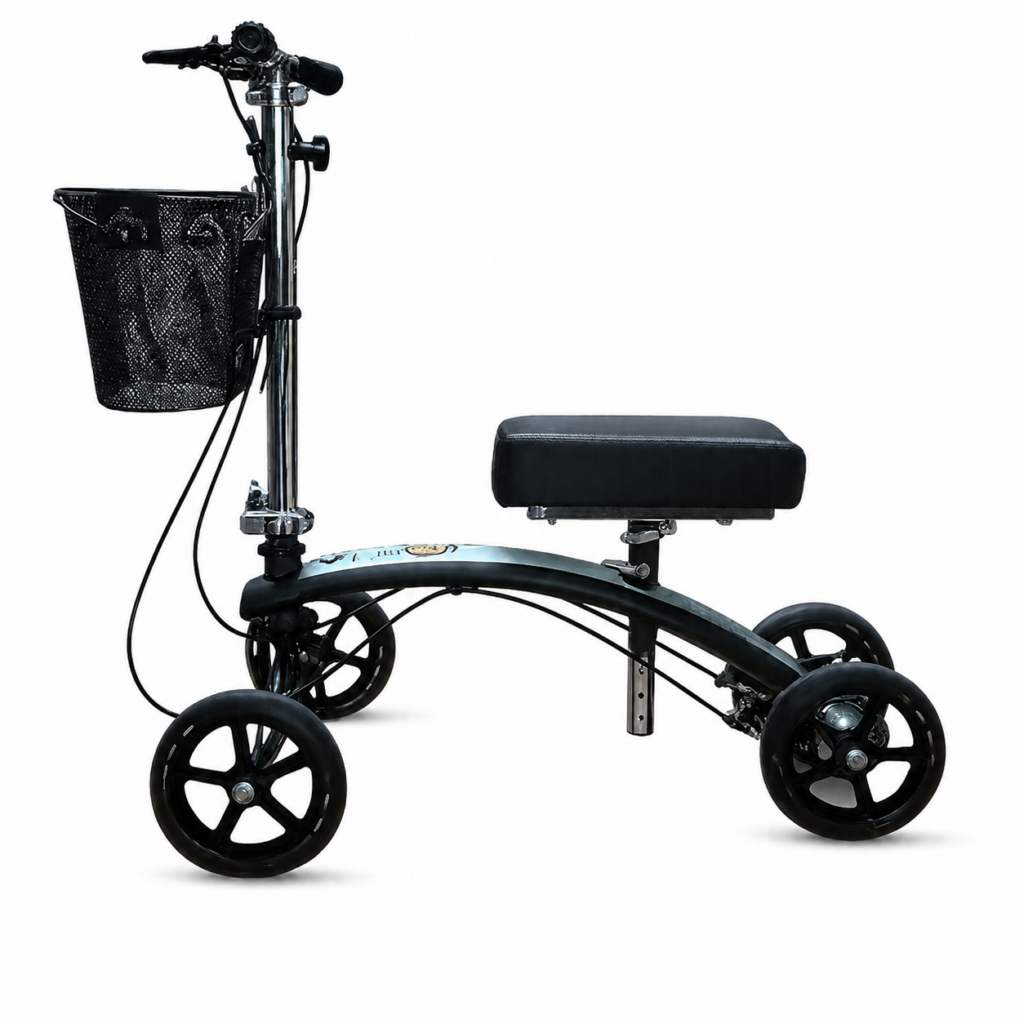
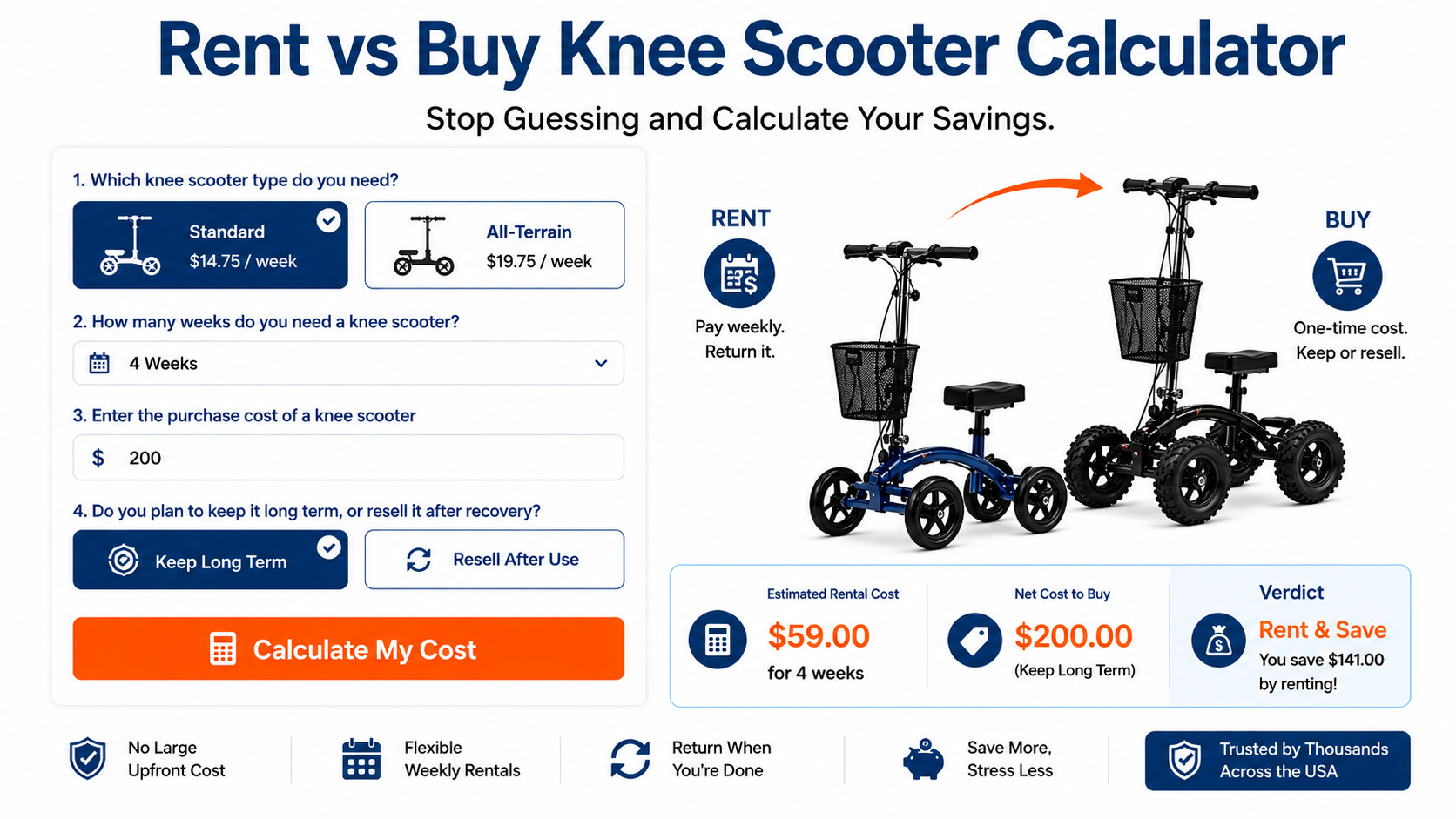
A standard knee scooter, with 7″ solid rubber tires, is built for indoor life: carpet, tile, hardwood floors, and sidewalks. It’s lighter, folds down compactly, and is the easier device to load into a car trunk or store in a hallway closet.
If most of your recovery is going to happen at home, in an office, or around town on paved surfaces, this is the one that makes sense.
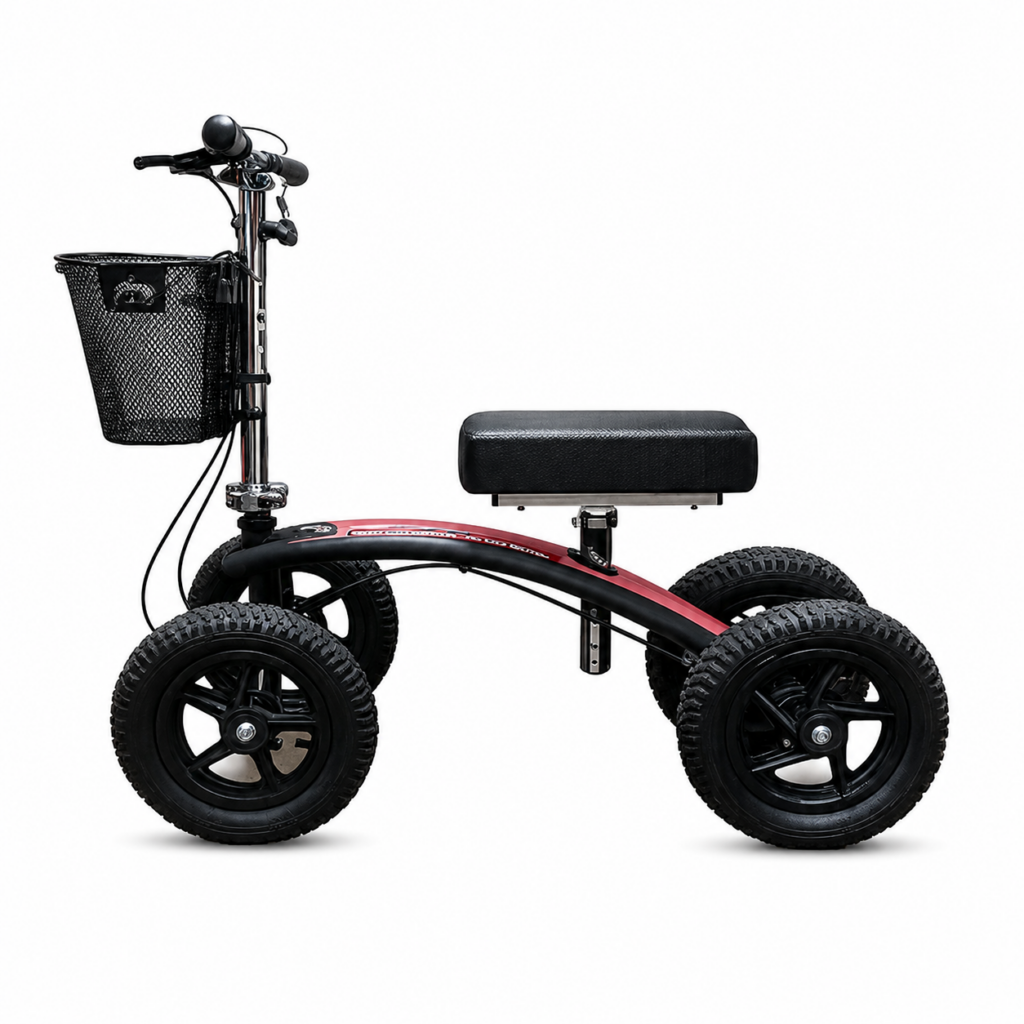
An all-terrain knee scooter swaps in 12″ air-filled mountain bike tires, and that single change matters the moment recovery moves outside. Gravel driveways, uneven yards, dirt paths, dog walks, surfaces that would jolt every bump straight into your knee on solid tires get absorbed by the bigger, air-filled wheels instead.
If you’re not willing to put life on pause for six weeks because of a broken foot, the all-terrain model is worth a few extra dollars a week.
Both models fit riders from roughly 4’9″ to 6’6″ and handle up to 350 lbs, and both come with HCPCS codes so you can submit for insurance reimbursement after the fact.
First Few Days On A Knee Scooter
The first day or two on a knee scooter usually comes with an adjustment period; steering takes a bit of practice, especially around tight corners and doorways. A quick look at how the scooters work beforehand helps that adjustment go faster. Most people report feeling confident on the knee scooter within a day.
A few habits make the early weeks easier:
- Keep the injured foot elevated whenever you’re sitting still because swelling slows healing more than people expect;
- Resist the urge to test weight on the foot. That’s how a two-week recovery quietly becomes a four-week one;
- Take corners and thresholds slowly until steering becomes second nature;
- Use a basket or bag on the handlebars so your hands stay free for actual mobility, not for carrying things.
As healing progresses and your doctor confirms it with a follow-up X-ray, you’ll likely transition to a walking boot before returning to regular shoes. Many people use both during that window, the boot for short trips, the scooter for anything longer, or when the leg gets tired
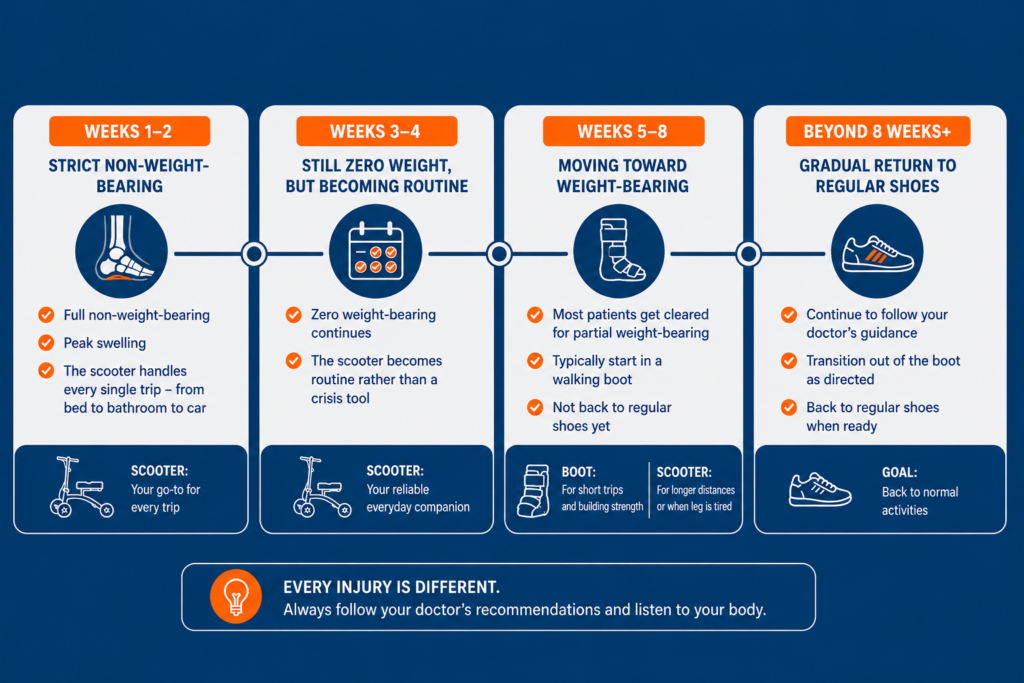
Timelines vary by injury, but a rough pattern shows up across most foot fractures and severe sprains. The first two weeks are the strictest: full non-weight-bearing, peak swelling, and the scooter handling every single trip from bed to bathroom to car.
Weeks three and four usually still call for zero weight, but the scooter becomes routine rather than a crisis tool.
Somewhere between weeks five and eight, most patients get cleared for partial weight-bearing, typically starting in a walking boot rather than jumping straight back into normal shoes.
Get Back On Your Feet Without Putting Weight On Them
For the large majority of foot fractures, foot surgeries, and severe ankle injuries, the answer to “can a scooter be used for a broken foot” is a clear yes, and for most people, it ends up being a far better experience than crutches.
The exceptions are narrow: an injured “good” knee, injuries above the knee, or bilateral leg injuries where there’s no healthy leg left to carry the load.
If your situation fits the typical profile, a knee scooter gets you back to moving through your own house and out the door without the soreness, the slow pace, or the two hands tied up just keeping you upright.
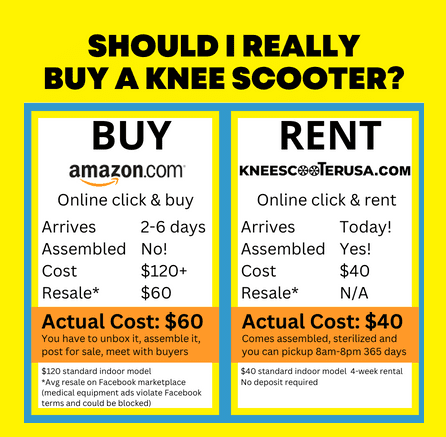
Knee Scooter USA offers same-day local pickup on both Standard and All-Terrain models, with no due dates and HCPCS codes provided for insurance reimbursement when you’re done.