


Knee Scooter vs Crutches vs Walker vs Wheelchair Savings Cost Calculator: Stop Overpaying
The doctor hands you a diagnosis, mentions you’ll need “something” to get around for the next few weeks, and sends you on your way. Nobody tells you that something comes with four very different price tags attached.
Run your numbers through the calculator below before you grab whatever’s sitting on the pharmacy shelf.
What Each Option Actually Costs You, Beyond the Price Tag
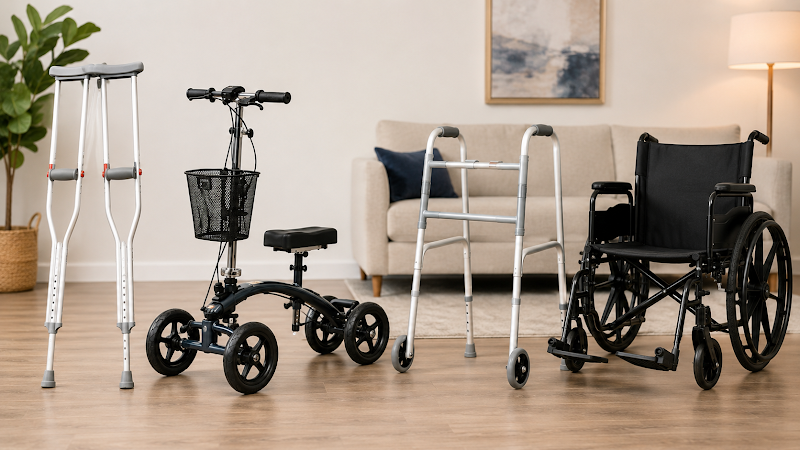
Every mobility aid solves the same basic problem: getting you upright and moving, but they get there in very different ways, and the weekly cost only tells half the story.
Crutches: Cheap Upfront, Costly on the Body
Crutches are the cheapest entry point, usually $15 a week or less, which is exactly why they’re the default. The trade-off shows up physically.
Underarm pressure, sore wrists, and a slower healing pace are common once you’re past the two-week mark, since most people unconsciously shift their weight to avoid pain.
If the physical toll is a concern, our breakdown of alternatives to crutches for knee and ankle injuries covers a few options worth considering before you commit.
Walkers: Stable, but Both Hands Tied Up
Walkers run a bit higher, typically around $35 a week, and offer more stability than crutches. The downside is speed and convenience. Both hands stay locked on the frame, which makes anything beyond a short trip around the house feel like a project.
Wheelchairs: The Priciest Trade for Independence
Wheelchairs are usually the priciest of the four, often $45 a week or more, and while they’re the right call for certain injuries, they hand you a different problem: loss of independence. Stairs, narrow doorways, and uneven ground all turn into obstacles, and someone else is often pushing.
Knee Scooters: Mobility Without the Trade-Offs
Knee scooters sit in a different category entirely. A Standard model runs $14.75 a week, an All-Terrain model runs $19.75 a week, and either one keeps your injured leg fully elevated while you move at close to a normal walking pace, one hand free the whole time.
For foot, ankle, or lower-leg injuries where putting weight down isn’t an option, that combination is hard to match. If you’re deciding between the two scooter types, the Standard vs. All-Terrain breakdown walks through which one fits your floors and your yard.
Break Down Your Recovery Costs in Seconds

The calculator above runs this math instantly, no math homework required, but here’s what’s actually happening behind each input.
Start with how long you’ll realistically need support. Pick anywhere from 1 week up to 8 weeks, based on what your doctor told you, rather than a guess.
Next, choose your scooter type: Standard for smooth indoor surfaces, All-Terrain if you’re dealing with yards, gravel, or rougher ground outside.
From there, you’ll enter your local weekly rates for crutches, a walker, and a wheelchair. We’ve defaulted those fields to $15, $35, and $45, which reflect common U.S. rental averages, but every field is editable, so you can plug in whatever your local provider actually charges.
Once you hit calculate, the calculator multiplies each weekly rate by your recovery duration, then stacks every option side by side against the scooter total, showing your exact savings or, in rare cases, where another option might come out cheaper.
A few patterns worth knowing before you run it:
- A 1-week recovery rarely shows a dramatic gap. Short timelines don’t give the weekly rate differences much room to compound.
- A 4- to 6-week recovery is where the numbers really separate. This is the range where a knee scooter’s lower weekly rate starts adding up to real savings against crutches, walkers, or a wheelchair.
- Comfort and independence don’t show up in the math, even though they matter just as much as the dollar amount. A scooter that costs a few dollars more but keeps both your hands and your sanity free is worth factoring in.
- Insurance sometimes covers part of the cost. It’s worth checking whether your insurance covers a knee scooter rental before you assume you’re paying full price out of pocket.
Getting the Most Accurate Numbers Out of the Calculator
The calculator is only as good as what you put into it: garbage in, garbage out, so a little prep makes a real difference.
- Confirm your recovery window with your doctor, not a guess based on how long a friend’s similar injury took. This single input swings your total more than anything else.
- Check actual local rental rates for crutches, walkers, and wheelchairs instead of relying on national averages, since pricing varies a fair amount by provider and region.
- Re-run it if your timeline changes. Recovery doesn’t always go on schedule, and the calculator updates instantly, so there’s no reason to work off outdated numbers.
- Think past just the rental price. If you’re also weighing whether renting beats buying outright, renting a knee scooter versus buying one lays out that side of the math, and our full rental cost breakdown covers regional pricing in more depth.
If you’ve never used a knee scooter before and aren’t sure it’s the right fit, our explainer on what a knee scooter is covers how it works and which injuries it’s best suited for.
Why People End Up With the Wrong Mobility Aid
Most people don’t actually choose their mobility aid; the decision gets made for them. It gets chosen for them, by whatever’s in stock, whatever a family member has lying around, or whatever the hospital hands over on the way out the door.
Crutches are usually the default, mostly because they’re cheap and everywhere, not because anyone sat down and compared the real cost over a full recovery.
That default works fine for a one-week sprain. It works a lot less well once recovery stretches into four, six, or eight weeks, which is where the cost gap between options actually starts to show up.
A few questions worth answering before you settle on anything:
- How long has your doctor actually said you’ll need support, and is that a firm number or a “we’ll see” estimate?
- Are you the kind of person who can manage crutches without underarm pain, or does that wear on you fast?
- Do you need both hands free during the day, for work, kids, or just carrying a coffee without falling over?
- Is the ground you’re walking on mostly smooth flooring, or are you dealing with yards, gravel, or uneven sidewalks?
- Have you actually priced out what crutches, a walker, or a wheelchair cost to rent in your area, or are you assuming?
That last one is the part most people skip. They’ll spend twenty minutes comparing knee scooter rental cost calculator results against a quick Google search, but they rarely run the same math on a walker or wheelchair sitting in a relative’s garage.
Our calculator exists specifically to close that gap.
Run Your Numbers and Get Moving
Plug your real recovery timeline into the calculator above and see exactly where you land, no more guessing involved. In most cases, a knee scooter comes out ahead on cost and on comfort, but the only way to know for your situation is to run your own numbers instead of guessing.
Staying mobile during recovery is about more than dollars, too, since staying active actually affects how well and how fast you heal.
Once you’ve got your results, pick up a knee scooter same-day at any Knee Scooter USA location, or check the FAQ if you’ve still got questions about billing or returns.