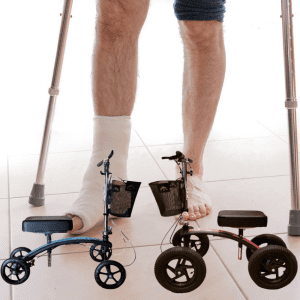
You booked the trip months ago. Then a fractured ankle showed up, and now you’re staring at a knee scooter, wondering if it’s even allowed past security.
Good news first: yes, you can take a knee scooter on an airplane.
Airlines treat mobility devices differently than regular luggage, and a knee scooter sits in a slightly awkward category. It’s not a wheelchair, but it gets handled like one in most of the situations that matter. Here’s exactly what to expect from check-in to baggage claim.
Knee Scooters Are Classified As Mobility Aids, Not Luggage
Under federal law (the Air Carrier Access Act), assistive devices like knee scooters travel free of charge and outside your regular baggage allowance. That means no checked-bag fee, no carry-on slot used up, and no weight limit fight at the counter.
Airlines are required to accommodate mobility devices, but “accommodate” mostly means transporting them safely in the cargo hold, not letting them ride in the cabin with you. A knee scooter is too bulky to fit in an overhead bin or under a seat, so it almost always travels as gate-checked cargo, similar to a wheelchair or walker.
TIP: Call the airline’s disability services line 48 hours before your flight and tell them you’re traveling with a knee scooter. This isn’t required everywhere, but it puts a note on your reservation and avoids confused gate agents on travel day.
Gate-Checking: The Part That Actually Matters
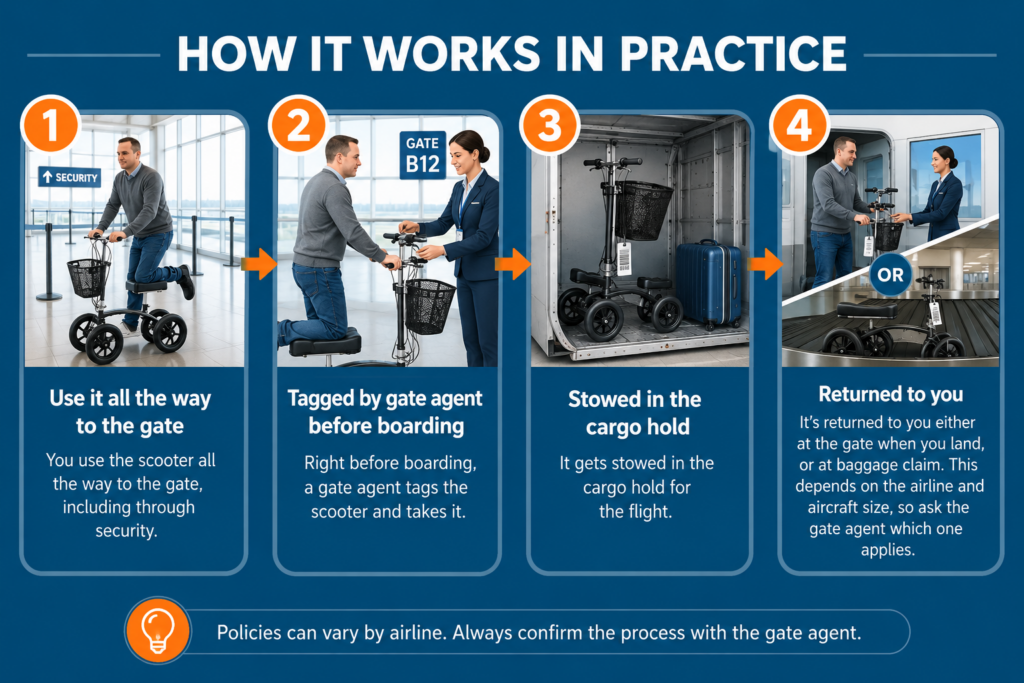
This is the step that trips people up. Here’s how it works in practice:
- You use the scooter all the way to the gate, including through security.
- Right before boarding, a gate agent tags the scooter and takes it.
- It gets stowed in the cargo hold for the flight.
- It’s returned to you either at the gate when you land, or at baggage claim. This depends on the airline and aircraft size, so ask the gate agent which one applies.
Because the scooter folds down, it’s manageable for cargo crews to load, unlike a powered wheelchair. Still, treat it the way you’d treat any checked equipment: expect some handling, and don’t pack anything fragile in the basket if yours has one.
PRO TIP: Remove any detachable accessories (basket, phone holder, bag) before handing it off at the gate. Cargo handling isn’t gentle, and small attachments are the first thing that go missing or snaps off.
Getting Through Security With A Knee Scooter
TSA allows mobility devices through security checkpoints, and agents are used to seeing knee scooters specifically. They’re common enough now that this isn’t a novel request.
What to expect:
- You’ll likely go through a slower, manual screening lane rather than the standard line.
- The scooter itself gets screened separately, usually with a swab test or a walk-through scanner pass.
- You can request a wheelchair escort from check-in to the gate if standing through the screening process for an extended time isn’t realistic on your injury.
Arrive earlier than usual. Manual screening takes longer than walking through a metal detector, and you don’t want to be doing this with five minutes until boarding.
Boarding And In-Flight: What Happens To Your Leg
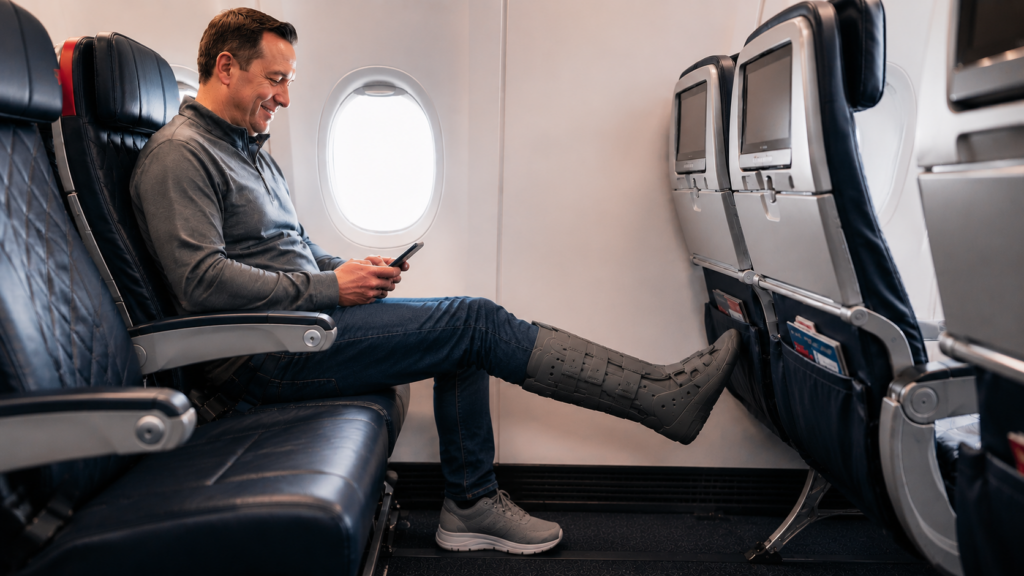
Once you’re past the gate-check step, you’re moving through the jet bridge without the scooter, usually on a wheelchair, with crutches, or supported by airline staff, depending on what you requested when booking. Ask for pre-boarding if you’ll need extra time getting down the aisle.
In your seat, your options are limited:
- Aisle seat if you can manage it, easier for elevating the leg slightly and getting up if needed.
- Bulkhead row, if available, gives a bit more room to stretch the injured leg.
- Bring a small pillow or rolled blanket to prop the foot if elevation helps with swelling on longer flights.
Long flights and a non-weight-bearing injury aren’t a great combination for circulation. If your trip is over a couple of hours, ask your doctor about it ahead of time.
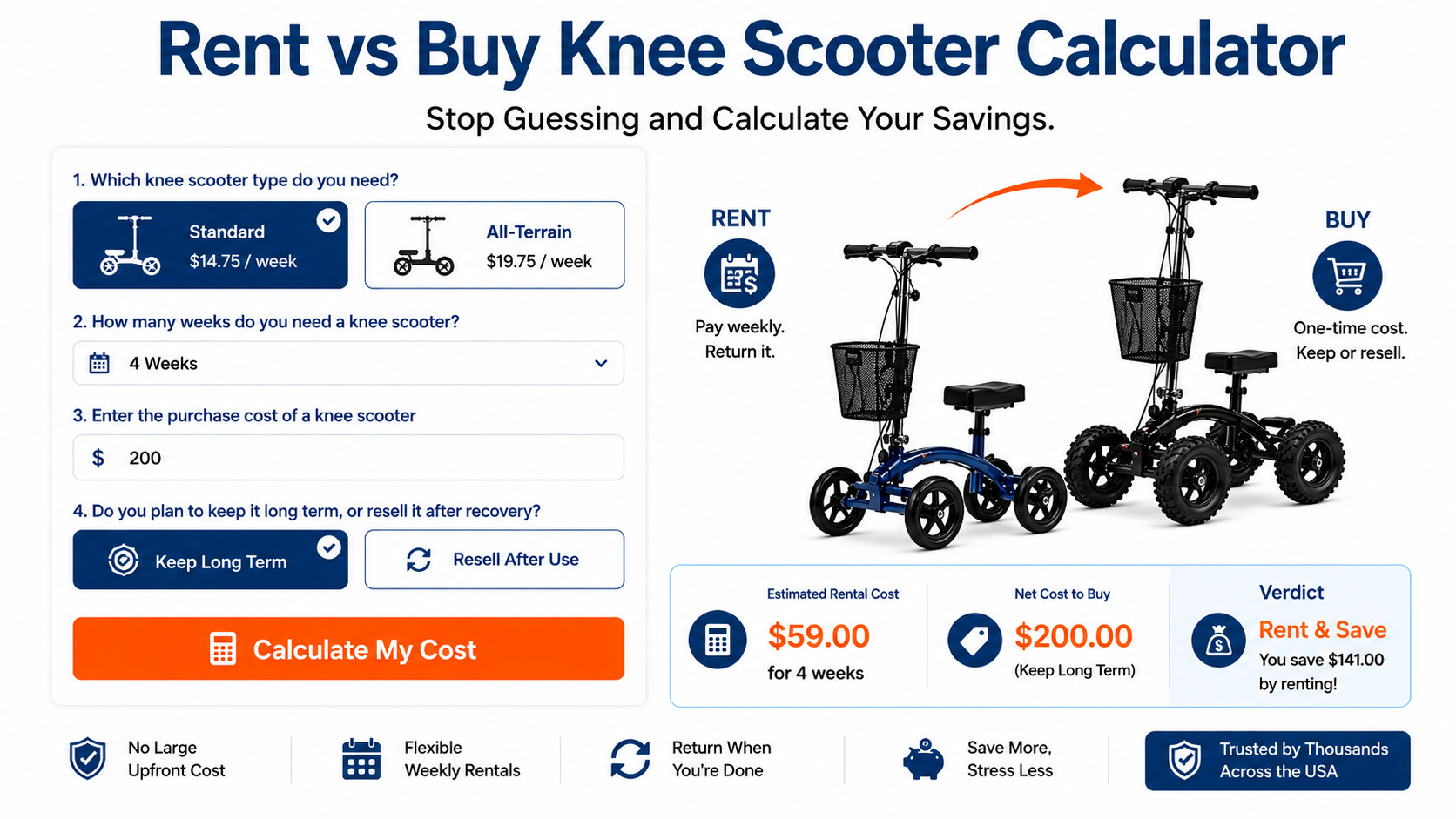
What About Renting Instead Of Flying With Your Own Scooter?
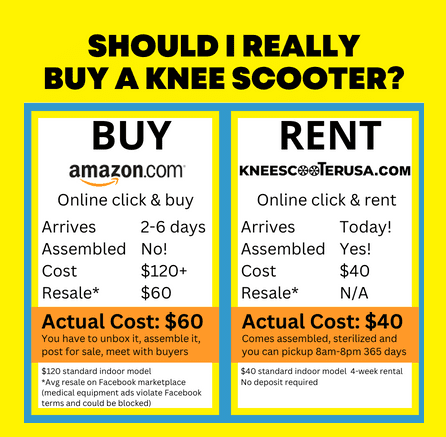
Here’s where the math gets interesting. If you’re flying to a destination and only need the scooter for a few days there, hauling your own scooter through two airports, security twice, and gate-check both ways is a lot of friction for something you could pick up locally instead.
Knee Scooter USA has rental locations across multiple states, with same-day pickup available 8 am to 8 pm, 365 days a year. Land, head to the nearest location, and you’re mobile within minutes, no scooter to manage at security, no risk of cargo damage, and nothing to gate-check on the way home either.
We have locations right where you are landing, including:
- Arizona: Phoenix, Tucson
- California: Sacramento, San Jose
- Colorado: Colorado Springs, Denver, Fort Collins, Wheat Ridge
- New Mexico: Albuquerque
- South Carolina: Greenville
- Texas: Austin, Arlington
Renting locally works well if you’re:
- Traveling for a wedding, work trip, or family visit and only need the scooter for the duration;
- Worried about your scooter getting damaged or lost in transit;
- Trying to pack light and avoid an extra oversized item at check-in.
If you do need a scooter for the destination, it’s worth comparing the standard versus all-terrain models before booking, because a beach trip or a hotel-and-conference-center trip call for different tires.
A Few Things To Confirm Before You Fly
Every airline has slightly different procedures, so before travel day:
- Call ahead and confirm the gate-check process for mobility devices on your specific airline;
- Ask whether your scooter will be returned at the gate or at baggage claim on arrival;
- Check if your connecting flights (if any) require re-checking the scooter at each stop;
- Confirm wheelchair escort availability for the security line and gate walk, if you’ll need one.
None of this is complicated once you know the steps, but finding it out at the airport, mid-injury, with a flight to catch is the wrong time to learn it.
If your trip only calls for a scooter at your destination, renting locally often beats hauling your own through two airports. Whichever way you go, recovery shouldn’t mean grounding your travel plans entirely, for plenty of ankle and foot injuries, a knee scooter just needs a little extra planning, not a cancelled trip.